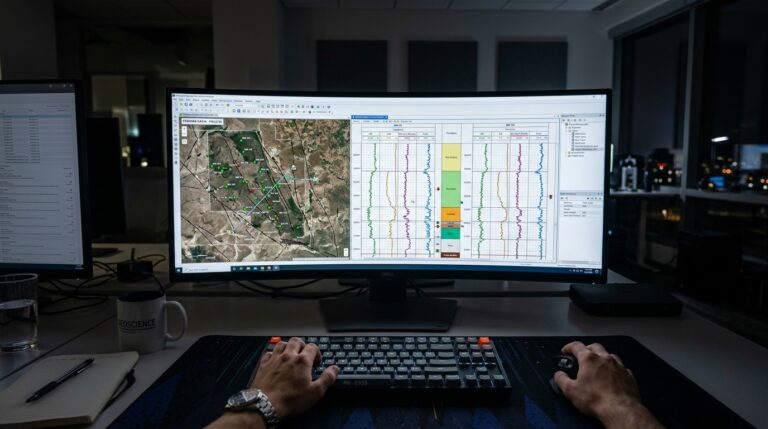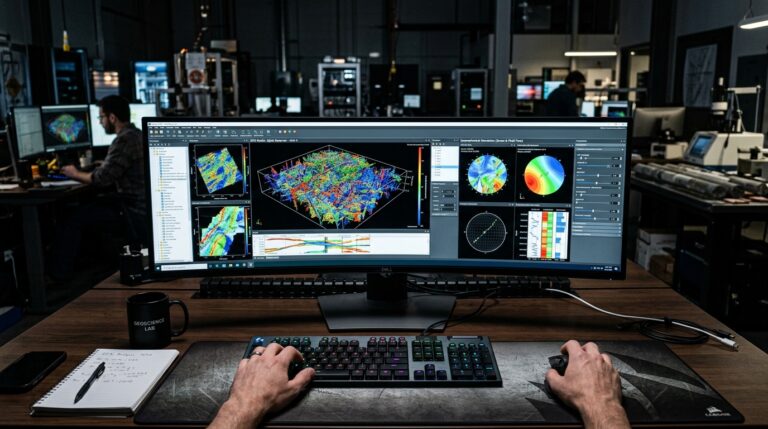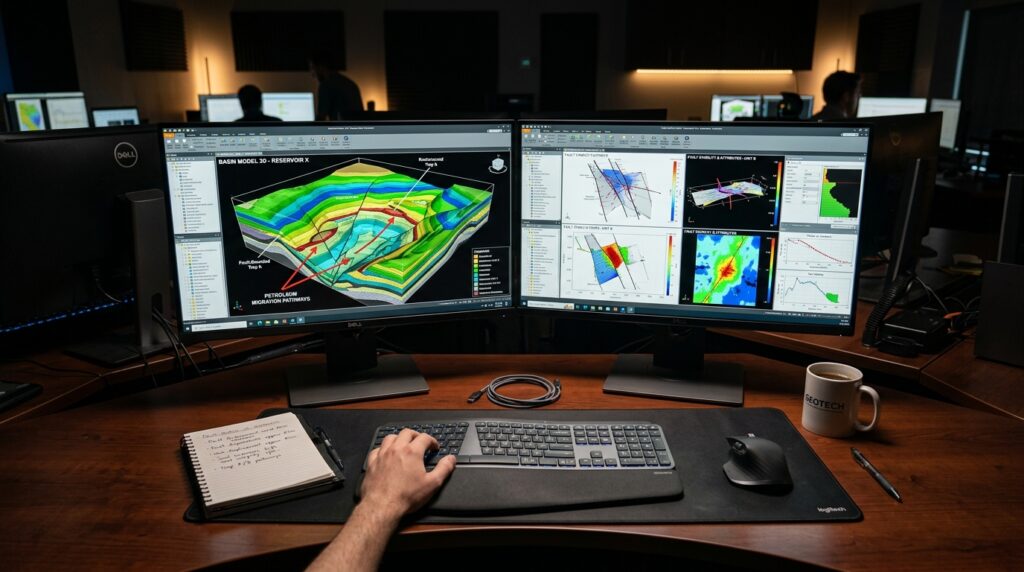
Geological interpretation and basin modeling workflows frequently require highly specialized tools for accurate risk assessment. For professionals engaged in structural trap and fault-seal analysis, a dedicated software solution can provide critical insights often beyond the scope of general interpretation platforms.
Need This Software?
Contact us to request the software and receive download and access information.
This article introduces TrapTester software, a specialized tool for detailed structural trap and fault-seal risking. It is important for readers to note that TrapTester is the prior branding for what is now known as T7 (T7 SEAL) software from Badley Geoscience Ltd. The capabilities described herein refer to the functionality available under both the original TrapTester product line and its successor, T7, ensuring evergreen relevance.
Key Facts
- Category: Structural Trap & Fault Seal Analysis Software
- Best for: Geologist / Geophysicist
- Also compare: StructureSolver, IKON RokDoc
What is TrapTester (T7) Software?
The TrapTester (T7) software is a purpose-built application designed to address the complexities of structural trap and fault-seal integrity within hydrocarbon exploration and production. It provides geologists and geophysicists with advanced analysis capabilities for evaluating the sealing capacity of faults and the associated risk to hydrocarbon columns. Unlike general interpretation suites that may offer limited or add-on functionalities, TrapTester (T7) focuses on providing comprehensive tools for this specific analytical challenge.
Core Capabilities for Fault and Trap Analysis
The TrapTester (T7) software offers a suite of integrated functionalities essential for robust structural trap and fault-seal risking. These capabilities are designed to provide a thorough understanding of subsurface conditions affecting hydrocarbon containment.
Fault Seal Analysis
A primary function of the software is its comprehensive fault seal analysis, which includes methodologies crucial for assessing fault integrity:
- Juxtaposition Analysis: Evaluate the stratigraphic juxtaposition across faults, identifying potential pathways for hydrocarbon leakage based on the contact between different lithologies.
- Shale Gouge Ratio (SGR): Quantify the clay smear potential along fault planes, a key indicator of fault sealing capacity. The software calculates SGR to predict the distribution of sealing and non-sealing segments along faults.
Fault and Trap Geometry Restoration
To accurately model present-day fault geometries and trap configurations, TrapTester (T7) includes tools for fault and trap geometry restoration. This capability helps users understand the evolution of structural features and their impact on sealing mechanisms over geological time, contributing to more reliable risk assessments.
Hydrocarbon Column Height and Trap Risk Analysis
The software facilitates detailed analysis of potential hydrocarbon column heights and provides comprehensive trap risk assessment. By integrating fault seal data with structural configurations, users can predict the maximum sustainable hydrocarbon column and quantify the associated risks of trap failure.
Petrel Data-Link Integration
Recognizing the prevalence of industry-standard software, TrapTester (T7) offers data-link integration with Schlumberger Petrel. This ensures a streamlined workflow, allowing geologists and geophysicists to leverage their existing seismic interpretation and geological models directly within the specialized fault-seal analysis environment of TrapTester (T7).
Why Choose TrapTester (T7) for Structural Trap and Fault-Seal Risking?
The core differentiator of TrapTester (T7) software lies in its specialization. While many general-purpose interpretation suites may offer add-on modules for basic fault-seal analysis, TrapTester (T7) is a purpose-built, niche specialist tool. This focus means it provides more depth, precision, and dedicated workflows for structural trap and fault-seal risking, an analysis type that general suites often handle superficially. Its dedicated approach leads to a more rigorous and reliable assessment for critical decisions in exploration and development.
Comparative Overview of Fault Seal and Structural Analysis Software
Understanding how TrapTester (T7) compares to other tools in the market can help professionals select the most appropriate software for their specific needs. The table below outlines its position relative to other commonly used or competing products in the geology and seismic interpretation category.
| Feature/Capability | TrapTester (T7) Software | General Interpretation Suites (e.g., Schlumberger Petrel) | Specialized Structural Analysis Tools (e.g., StructureSolver, IKON RokDoc) |
|---|---|---|---|
| Primary Focus | Specialized structural trap and fault-seal risking | Comprehensive seismic interpretation, modeling, and reservoir characterization | Diverse structural geology applications, often with modular components |
| Fault Seal Analysis Depth | Deep, purpose-built with juxtaposition and SGR quantification | Often via add-on modules, potentially less depth in dedicated algorithms | Varies by specific tool; some may include detailed fault seal, others focus on deformation |
| Hydrocarbon Column/Trap Risk | Integrated and central to the workflow | May require integration of multiple modules or external tools | Can provide structural context, but may not directly quantify column height/risk |
| Petrel Data Link | Direct, documented integration | Native data environment | Varies; some may have integration options |
| Niche Specialization | High; dedicated entirely to fault-seal and structural trap integrity | Lower; broad application across E&P workflows | Moderate to high; focused on specific aspects of structural geology |
Who Benefits from TrapTester (T7) Software?
Geologists and geophysicists working in exploration, appraisal, and development will find the petroleumsoftware.ir listed TrapTester (T7) software particularly beneficial. Its specialized capabilities are crucial for:
- Reducing uncertainty in hydrocarbon prospect evaluation by accurately assessing trap integrity.
- Optimizing well placement by understanding fault behavior and sealing characteristics.
- Validating and refining structural models with rigorous fault-seal analysis.
- Performing detailed risk assessments for critical investment decisions.
Frequently Asked Questions about TrapTester (T7) Software
What are the primary applications of TrapTester (T7) software in geological studies?
TrapTester (T7) is primarily applied in structural trap and fault-seal risking within hydrocarbon exploration, appraisal, and development projects. It is used to evaluate trap integrity, optimize well placement, and refine structural models.
How does TrapTester (T7) enhance the accuracy of fault seal analysis compared to other methods?
TrapTester (T7) enhances accuracy through its dedicated, purpose-built algorithms for juxtaposition analysis and Shale Gouge Ratio (SGR) quantification. This focused approach provides deeper insights into the sealing capacity of faults compared to general interpretation suites, leading to more rigorous and reliable assessments.
Can TrapTester (T7) be used for both exploration and production phase projects?
Yes, TrapTester (T7) is suitable for both exploration and production phase projects. Its capabilities are beneficial for reducing uncertainty in hydrocarbon prospect evaluation during exploration and for optimizing well placement and validating structural models in appraisal and development.
What types of data inputs are typically required for analysis in TrapTester (T7)?
Typical data inputs for analysis in TrapTester (T7) include structural models, fault plane geometries, seismic interpretations, stratigraphic data, and lithological information, often imported via integration with industry-standard software like Petrel.
How does TrapTester (T7) aid in hydrocarbon column height prediction?
TrapTester (T7) aids in hydrocarbon column height prediction by integrating fault seal analysis data with structural configurations. This allows users to determine the maximum sustainable hydrocarbon column height and quantify the associated risks of trap failure based on the integrity of the sealing elements.
Need Access to This Software?
Need this software for your project? Contact us for download access, availability, and related information.
Conclusion
TrapTester (T7) software is ideally suited for geologists and geophysicists who require a highly specialized and precise tool for structural trap and fault-seal risking. Its focused capabilities in juxtaposition analysis, SGR quantification, and integration with established workflows make it an invaluable asset for critical decisions in hydrocarbon exploration and development, offering a level of depth often beyond general interpretation platforms. To explore how TrapTester (T7) software can integrate with your specific geological workflows and enhance your project outcomes, submit an inquiry through our dedicated request form.