Reservoir simulation forms the backbone of petroleum asset management, enabling engineers to predict reservoir behavior, optimize production strategies, and evaluate enhanced oil recovery (EOR) opportunities. Among the tools available, Schlumberger Eclipse has long held a prominent position as a widely adopted and validated commercial reservoir simulator.
Need This Software?
Contact us to request the software and receive download and access information.
This article provides a technical overview of Schlumberger Eclipse, detailing its capabilities for black-oil, compositional, thermal, and streamline simulation. It aims to assist Reservoir Engineers and Simulation Specialists in assessing how Eclipse’s established, general-purpose framework aligns with their diverse reservoir modeling and forecasting requirements.
Key Facts
- Category: Reservoir Simulation
- Best for: Reservoir Engineer / Simulation Specialist
- Also compare: Schlumberger INTERSECT, CMG (Computer Modelling Group) Simulators
What is Schlumberger Eclipse Software?
Schlumberger Eclipse is a comprehensive suite of reservoir simulation tools designed to cover the full spectrum of reservoir modeling challenges. Developed by SLB, it is utilized across diverse workflows for conventional and unconventional reservoirs, supporting decisions from field development planning to long-term production forecasting. Its extensive adoption across over 800 sites in 70 countries underscores its reputation as an industry reference.
Core Simulation Capabilities
The Eclipse software family is built around two primary simulators, offering flexibility for various reservoir fluid systems:
- Eclipse 100 (Black-Oil Simulator): This module handles black-oil reservoir modeling, which is suitable for many conventional oil and gas reservoirs where fluid properties can be adequately represented by oil, gas, and water phases.
- Eclipse 300 (Compositional Simulator): For more complex fluid systems, such as volatile oil, gas condensate, or gas injection processes, Eclipse 300 provides compositional simulation capabilities. It models the phase behavior of hydrocarbon mixtures based on their individual components.
Beyond these core fluid models, Eclipse also integrates:
- Thermal Finite-Volume Simulation: For processes involving heat transfer within the reservoir.
- Streamline Simulation: Offering an alternative approach for flow diagnostics and rapid reservoir management studies.
Key Features for Advanced Reservoir Modeling
Schlumberger Eclipse includes a range of advanced features and add-on options to address specific engineering challenges:
- Enhanced Oil Recovery (EOR) Module: A dedicated module for modeling polymer flooding, utilizing a modified Todd-Longstaff approach. This accounts for critical factors such as polymer-water mixing, adsorption effects, and the influence of brine/salinity on flood efficiency.
- Thermal Simulation Options: Comprehensive capabilities to simulate various thermal recovery processes, including Steam Assisted Gravity Drainage (SAGD), cyclic steam injection, steam flooding, hot/cold water injection, and in-situ combustion.
- Specialized Reservoir Features: Options for local grid refinement to enhance resolution in critical areas, coalbed methane modeling, and specialized handling for gas-field operations.
- Advanced Well Modeling: Capabilities to represent complex well architectures and controls.
- Reservoir Coupling and Surface Networks: Tools for integrating reservoir models with surface facility networks to simulate the full production system.
Integration with the Petrel Environment
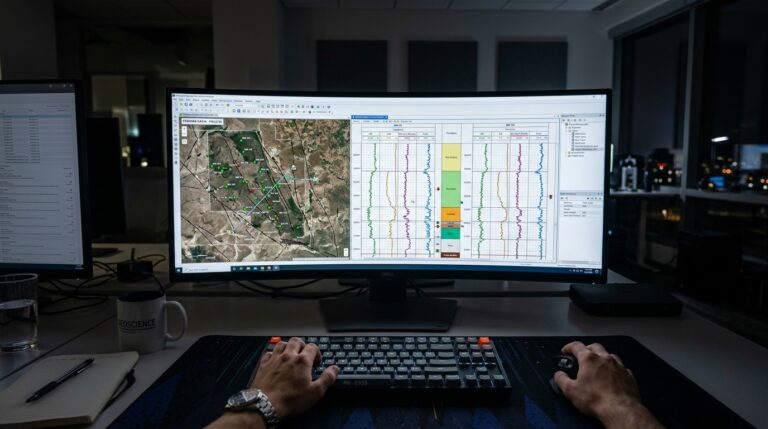
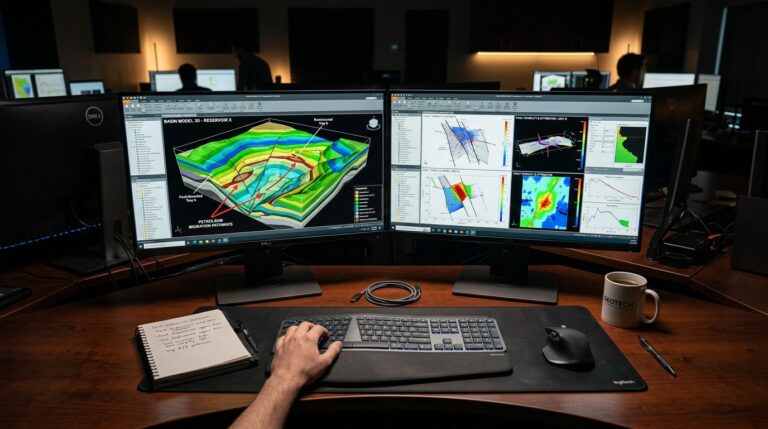
Schlumberger Eclipse runs within the Petrel Reservoir Engineering environment. This integration allows users to leverage the broader Petrel platform for geological modeling, petrophysical analysis, and visualization, creating a streamlined workflow from subsurface characterization to reservoir simulation and production optimization.
Why Choose Schlumberger Eclipse? Differentiators for Reservoir Engineers
For over 40 years, Schlumberger Eclipse has served as a benchmark in commercial reservoir simulation. Its primary differentiator lies in its breadth and maturity as a general-purpose workhorse. It offers a single family of simulators capable of handling black-oil, compositional, thermal, and streamline models, supported by decades of validation across diverse reservoir types. This contrasts with tools designed for highly specialized or very large-scale, high-resolution models. The software’s extensive use by academia, regulatory authorities, and petroleum financial planners, in addition to operators, further establishes its position as a de facto industry reference simulator for decision-making and forecasting.
Comparing Schlumberger Eclipse with Other Reservoir Simulators
Understanding where Schlumberger Eclipse fits within the broader landscape of reservoir simulation tools is crucial for selecting the right software for specific project requirements. Below is a comparison with other notable products in the category.
| Product Name | Category | Key Differentiator (Contextual to Eclipse) |
|---|---|---|
| Schlumberger Eclipse | Reservoir Simulation | Long-standing, validated general-purpose workhorse covering black-oil, compositional, thermal, and streamline simulation in a single family. |
| Schlumberger INTERSECT | Reservoir Simulation | Focus on very large, high-resolution, or geomechanically complex reservoir models. |
| CMG (Computer Modelling Group) Simulators | Reservoir Simulation | Offers a suite of advanced reservoir simulators, including compositional, thermal, and unconventional reservoir capabilities. |
| RFD tNavigator | Reservoir Simulation | Known for its high-performance computing capabilities and integrated geological modeling and visualization. |
| Nexus VIP | Reservoir Simulation | Provides a comprehensive suite for black-oil, compositional, and thermal simulation with a focus on advanced reservoir engineering workflows. |
Who Benefits from Schlumberger Eclipse Software?
The comprehensive capabilities and long-standing industry presence of Schlumberger Eclipse make it suitable for a wide range of professionals and organizations:
- Reservoir Engineers: For field development planning, production forecasting, decline curve analysis, and EOR studies.
- Simulation Specialists: Requiring robust and validated tools for complex fluid flow and thermal processes.
- Research Institutions and Academia: Utilizing a recognized industry standard for studies and educational purposes.
- Regulatory Bodies: Relying on an established benchmark for reserves estimation and environmental impact assessments.
- Petroleum Financial Planners: Leveraging its forecasting capabilities for economic evaluations and investment decisions.
Frequently Asked Questions about Schlumberger Eclipse
What types of fluid models can be simulated using Schlumberger Eclipse?
Schlumberger Eclipse supports black-oil models (Eclipse 100) for conventional oil and gas reservoirs, compositional models (Eclipse 300) for complex fluid systems like volatile oil or gas condensates, and thermal models for processes involving heat transfer.
How does Eclipse support enhanced oil recovery (EOR) projects?
Eclipse includes a dedicated EOR module, particularly for polymer flooding, which models polymer-water mixing, adsorption effects, and the influence of brine/salinity. It also provides comprehensive thermal simulation options for various thermal EOR methods.
Can Eclipse be integrated with other reservoir engineering tools?
Yes, Schlumberger Eclipse operates within the Petrel Reservoir Engineering environment, facilitating integration with Petrel’s broader capabilities for geological modeling, petrophysical analysis, and visualization workflows.
What makes Schlumberger Eclipse a widely adopted benchmark in the industry?
Eclipse’s status as a benchmark stems from its over 40 years of service as a general-purpose, validated simulator, its comprehensive capabilities across black-oil, compositional, thermal, and streamline models, and its extensive use by operators, academia, regulatory bodies, and financial planners globally.
Which specific thermal recovery methods can be modeled with Eclipse?
Eclipse offers comprehensive thermal simulation capabilities to model processes such as Steam Assisted Gravity Drainage (SAGD), cyclic steam injection, steam flooding, hot/cold water injection, and in-situ combustion.
Need Access to This Software?
Need this software for your project? Contact us for download access, availability, and related information.
Conclusion
Schlumberger Eclipse stands as a robust and extensively validated reservoir simulator, well-suited for Reservoir Engineers and Simulation Specialists seeking a comprehensive, general-purpose tool for diverse reservoir modeling and simulation challenges. Its integrated approach to black-oil, compositional, thermal, and streamline simulation, combined with its long-standing industry presence, positions it as a reliable benchmark for critical decision-making across the asset lifecycle. To determine if Schlumberger Eclipse aligns with your specific reservoir simulation and modeling requirements, submit an inquiry through the petroleumsoftware.ir request form to connect with our experts.
Source: Source

Hello, does Schlumberger Eclipse require specialized hardware or a dongle to run properly?