
In the complex world of subsurface engineering, reservoir engineers and simulation specialists require robust tools that not only accurately model fluid flow but also provide a broader understanding of the geological context and future energy scenarios. The Open Flow Suite, developed by Beicip-Franlab, offers a comprehensive platform designed to address these multifaceted challenges, integrating various modeling disciplines into a single environment. This article provides a technical overview of the Open Flow Suite, focusing on its capabilities for reservoir simulation and its broader applications that are relevant to integrated subsurface project assessment, including the evolving landscape of energy transition initiatives.
Need This Software?
Contact us to request the software and receive download and access information.
The software is designed to support the rigorous analysis required for both conventional hydrocarbon reservoirs and emerging energy applications. By consolidating functionalities such as stratigraphic modeling, basin modeling, and fracture characterization with advanced fluid-flow simulation, Open Flow Suite enables a holistic approach to subsurface evaluation. This integration is crucial for professionals seeking to optimize reservoir performance, assess EOR strategies, or evaluate the feasibility of geothermal and carbon capture and storage projects.
Key Facts
- Category: Reservoir Simulation & Modeling
- Best for: Reservoir Engineer / Simulation Specialist
- Also compare: Schlumberger Eclipse, CMG + CoFlow
Understanding the Open Flow Suite for Reservoir Engineering
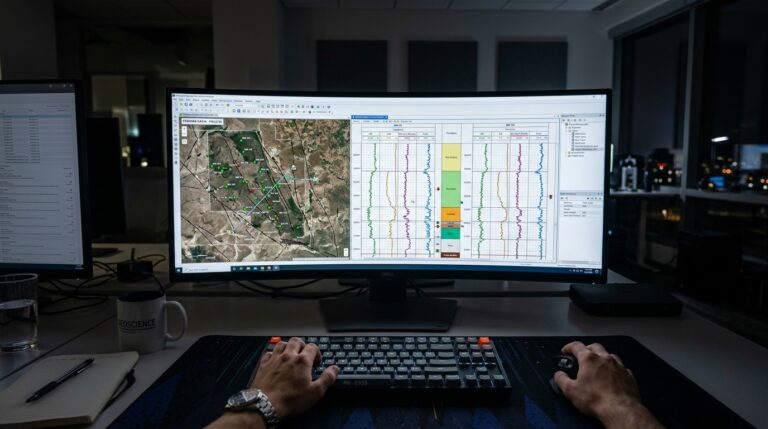
The Open Flow Suite functions as an integrated platform that bundles several specialized modules, each contributing to a holistic view of the subsurface. While a reservoir engineer’s primary focus may be on fluid-flow dynamics, the suite’s comprehensive nature means that geological, basin, and fracture characteristics can be considered within the same environment, facilitating more accurate and contextualized reservoir models. This integration is particularly valuable when assessing complex reservoirs or projects with significant geological uncertainties.
Key Modules and Their Role in Subsurface Analysis
The Open Flow Suite comprises a set of interconnected modules, each designed for specific aspects of E&P and energy transition workflows. For reservoir engineers, understanding how these modules complement core simulation tasks is essential.
PumaFlow: The Core of Reservoir and EOR Fluid-Flow Simulation
At the heart of the suite for reservoir engineers is PumaFlow, the module dedicated to reservoir and EOR (Enhanced Oil Recovery) fluid-flow simulation. PumaFlow is engineered to model complex subsurface fluid dynamics, providing insights into reservoir performance, production optimization, and the efficiency of various recovery methods. Its capabilities extend beyond conventional oil and gas, supporting analysis for:
- Geothermal energy projects: Simulating heat and fluid transfer in geothermal reservoirs.
- Natural hydrogen, helium, and lithium exploration: Modeling the flow and accumulation of these critical resources.
- CO2 storage screening and monitoring: Evaluating the feasibility and safety of carbon capture and storage sites.
Beyond Simulation: Supporting Modules for Integrated Projects
The Open Flow Suite integrates additional modules that, while not solely focused on reservoir simulation, provide critical contextual data and modeling capabilities that influence reservoir behavior and project viability:
- DionisosFlow: Stratigraphic Modeling: For understanding the depositional architecture and sedimentological controls on reservoir quality and distribution.
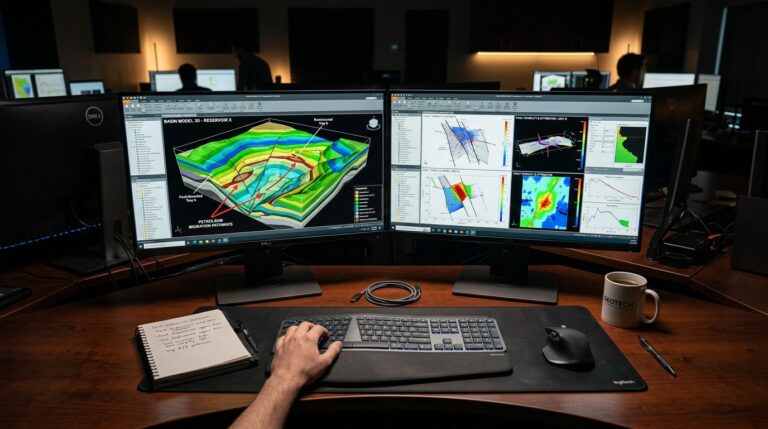
- TemisFlow: Basin Modeling and Petroleum Systems Analysis: Essential for evaluating the maturity, generation, migration, and accumulation of hydrocarbons, as well as broader basin-scale fluid flow.
- KronosFlow: Kinematic Petroleum-System Modeling: Provides insights into the timing and evolution of petroleum systems.
- CougarFlow: Natural-Fracture Characterization: Crucial for modeling fractured reservoirs, where natural fractures significantly impact fluid flow pathways and permeability.
Advanced Simulation Capabilities and Techniques
The Open Flow Suite incorporates advanced numerical schemes and methodologies to enhance simulation accuracy and efficiency:
- Numerical schemes for early diagenesis, addressing the impact of early rock-fluid interactions on reservoir properties.
- Advanced fluid injection modeling, crucial for EOR, CO2 storage, and geothermal projects.
- Integrated geomechanics, allowing for the analysis of stress and strain within the reservoir, which can affect permeability and wellbore stability.
- Hybrid upscaling methods that combine both analytical and flow-based solutions, optimizing the balance between computational efficiency and geological realism in reservoir models.
The Integrated Platform Advantage: A Key Differentiator
A primary differentiator of the Open Flow Suite is its comprehensive breadth across the full subsurface energy transition workflow within one connected platform. Unlike single-purpose reservoir simulators that focus exclusively on the simulation step, the Open Flow Suite provides tools for reservoir simulation, stratigraphic modeling, basin modeling, and fracture characterization. This integrated approach allows reservoir engineers to contextualize their simulations with a deeper understanding of the entire subsurface system, from basin-scale evolution to detailed fracture networks. This connectivity streamlines workflows and reduces the need for data transfer and integration between disparate software tools, fostering a more consistent and holistic project assessment, particularly for complex and multi-disciplinary energy transition projects handled on petroleumsoftware.ir.
Cloud Deployment for Enhanced Accessibility and Performance
The Open Flow Suite is available as a cloud-based deployment, offering several advantages for reservoir engineers and simulation specialists:
- Global Accessibility: Enables users to access the software from anywhere, facilitating collaborative work across different locations.
- High-Performance Computing: Leverages cloud infrastructure for demanding simulations, allowing for faster processing and the handling of larger, more complex models.
- Always Up-to-Date: Ensures users are working with the most current version of the software, benefiting from the latest features and performance enhancements without manual updates.
Open Flow Suite vs. Other Reservoir Simulation Software
Understanding how the Open Flow Suite positions itself relative to other tools in the market can help reservoir engineers make informed decisions. While many excellent reservoir simulators exist, the key distinction often lies in their scope and integration.
| Product Name | Primary Focus / Key Differentiator |
|---|---|
| Beicip-Franlab Open Flow Suite | Comprehensive, integrated platform for reservoir simulation, stratigraphic modeling, basin modeling, and fracture characterization across conventional E&P and energy transition workflows (geothermal, CO2 storage, natural H/He/Li). |
| Schlumberger Eclipse | Primarily a high-performance, single-purpose reservoir simulator focused on fluid-flow dynamics. |
| CMG + CoFlow | Primarily a suite of reservoir simulation tools, with CoFlow expanding into surface network modeling. |
| RFD tNavigator | High-performance, single-purpose reservoir simulator known for speed and scalability. |
Why Choose Open Flow Suite for Your Reservoir Engineering Workflow
For reservoir engineers and simulation specialists navigating the complexities of modern subsurface projects, including the growing demands of energy transition, the Open Flow Suite offers a compelling solution. Its strength lies in providing a unified environment where detailed reservoir simulation (via PumaFlow) is inherently linked to broader geological and basin-scale understanding. This integrated approach facilitates more robust decision-making, reduces project cycle times, and supports the comprehensive assessment required for both conventional hydrocarbon extraction and emerging energy resources like geothermal, natural hydrogen, and CO2 storage. The ability to access this powerful suite via a cloud deployment further enhances its utility, providing flexible, high-performance computing capabilities essential for contemporary engineering challenges.
Frequently Asked Questions (FAQ)
What types of reservoirs can Open Flow Suite model?
Open Flow Suite, through its PumaFlow module and supporting modules, can model a wide range of reservoirs including conventional oil and gas, fractured reservoirs (via CougarFlow), geothermal reservoirs, and sites for CO2 storage. Its integrated nature allows for considering detailed geological and basin-scale characteristics from DionisosFlow and TemisFlow.
How does Open Flow Suite support energy transition projects?
The suite supports energy transition projects by offering dedicated capabilities within PumaFlow for simulating geothermal energy production, modeling the flow and accumulation of natural hydrogen, helium, and lithium, and evaluating CO2 storage sites for screening and monitoring purposes. Its integrated platform allows for a comprehensive assessment of these emerging energy resources.
Can Open Flow Suite integrate with external geological models?
The Open Flow Suite emphasizes an integrated approach, where modules like DionisosFlow and TemisFlow provide internal stratigraphic and basin modeling capabilities. This design is intended to reduce the need for external data transfer and integration with disparate software tools, fostering a consistent modeling environment within the suite itself. The core strength lies in its ability to generate and utilize geological context directly.
What are the benefits of using the cloud-based deployment of Open Flow Suite?
Cloud-based deployment of Open Flow Suite offers global accessibility, enabling engineers to work collaboratively from various locations. It leverages high-performance computing infrastructure in the cloud for faster processing of complex simulations. Additionally, users benefit from always working with the most current software version, ensuring access to the latest features and performance enhancements without manual updates.
How does Open Flow Suite’s comprehensive platform benefit a reservoir engineer’s workflow?
The comprehensive platform benefits a reservoir engineer’s workflow by providing a holistic view of the subsurface within a single environment. This integration allows for contextualizing detailed reservoir simulations with broader geological and basin-scale understanding, streamlining workflows by reducing data transfer between disparate tools. It facilitates more robust decision-making and supports multi-disciplinary projects, particularly those involving complex conventional or energy transition scenarios.
Need Access to This Software?
Need this software for your project? Contact us for download access, availability, and related information.
Conclusion
The Open Flow Suite is well-suited for reservoir engineers and simulation specialists who require an integrated, multi-disciplinary approach to subsurface modeling. Its core reservoir simulation capabilities, combined with modules for stratigraphic, basin, and fracture characterization, enable a holistic understanding of reservoir behavior, critical for both conventional E&P and the growing demands of energy transition initiatives. This integrated environment streamlines complex workflows, making it a robust choice for comprehensive project assessment. To explore how Open Flow Suite can optimize your specific reservoir engineering and subsurface modeling projects, submit an inquiry through petroleumsoftware.ir.
Source: Source

Hi, is Beicip-Franlab Open Flow Suite: Integrated Subsurface Modeling for Reservoir Engineers available with full module access? Also, what are the system requirements for large-scale model simulation?