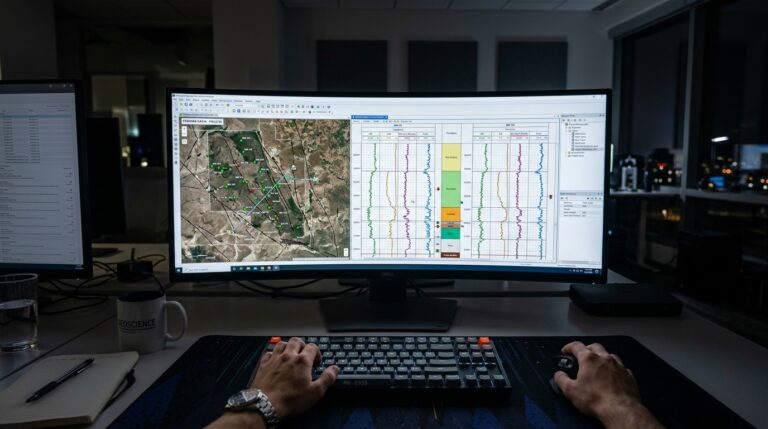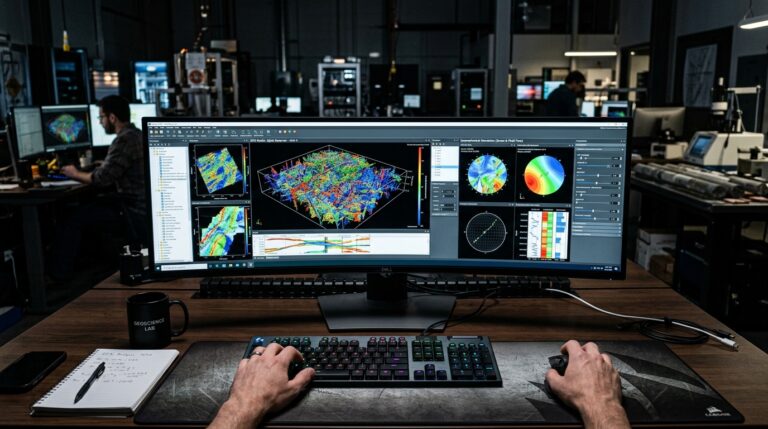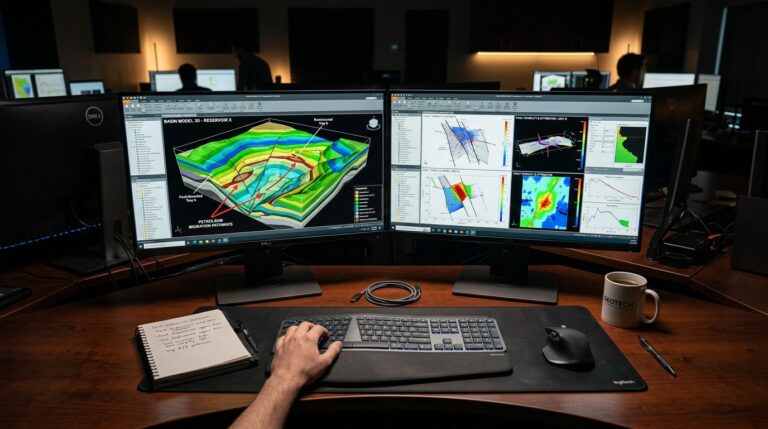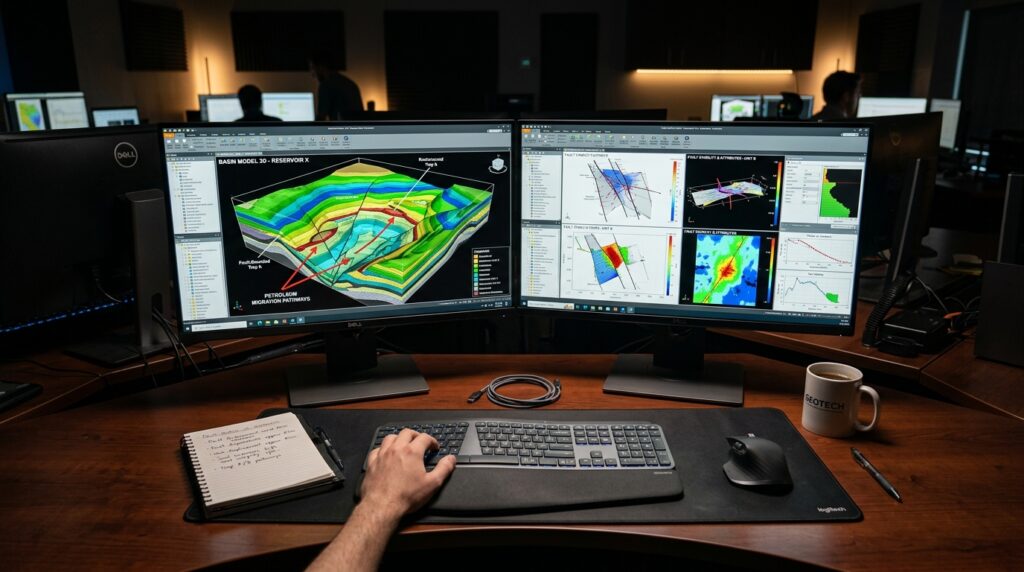
Understanding subsurface structures is critical in petroleum exploration and production. Geologists and geophysicists rely on specialized software to accurately model and interpret complex geological formations. This article introduces StructureSolver, a dedicated tool designed for 2D structural cross-section balancing and restoration, offering a focused approach to validating geological models.
For professionals evaluating the integrity of subsurface structures and the evolution of fault geometries, StructureSolver provides a specialized environment. It is designed to rigorously test structural interpretations, supporting workflows that confirm trap viability and reduce exploration risk by ensuring geological consistency in cross-section models.
Need This Software?
Contact us to request the software and receive download and access information.
Key Facts
- Category: 2D Structural Cross-Section Balancing and Restoration
- Best for: Geologist / Geophysicist
- Also compare: TrapTester, IKON RokDoc
What is StructureSolver?
StructureSolver is a specialized software application developed for interactive 2D structural cross-section balancing and restoration. Its core function is to allow geologists and geophysicists to test the validity of their structural interpretations through rigorous kinematic forward and backward modeling. This capability is essential for confirming trap integrity and understanding the evolution of fault geometries in prospect evaluation.
Key Capabilities for Structural Analysis
StructureSolver provides a suite of tools engineered to support detailed structural analysis workflows. These capabilities enable professionals to construct and validate geologically sound models, crucial for reducing exploration risk.
Interactive 2D Structural Cross-Section Balancing and Restoration
The software offers interactive tools for building and validating 2D structural cross-sections. This includes the ability to perform both forward (modeling deformation) and backward (restoring to undeformed state) kinematic modeling. Users can dynamically adjust parameters and observe the impact on structural integrity, ensuring geological consistency.
Fault-Geometry and Trap-Evolution Analysis
StructureSolver facilitates in-depth analysis of fault geometries and the evolution of hydrocarbon traps over geological time. By applying restoration techniques, users can reconstruct past structural configurations, evaluate the timing of trap formation relative to hydrocarbon generation, and assess the integrity of fault seals.
Kinematic Forward and Backward Modeling
A fundamental feature of StructureSolver is its capacity for kinematic forward and backward modeling. This allows for the precise simulation of deformation processes and the restoration of deformed sections to their original, undeformed state. This iterative process is vital for testing hypotheses about structural development and verifying interpretations.
Integration-Friendly Workflows for Structural Risk Assessment
StructureSolver is designed with integration in mind, supporting workflows that contribute to comprehensive structural risk assessment. While a standalone tool for its core functions, its outputs can be incorporated into broader interpretation frameworks. This helps professionals evaluate the uncertainty associated with structural interpretations and quantify geological risks.
Why StructureSolver Stands Out
In a landscape of comprehensive interpretation suites, StructureSolver distinguishes itself as a focused, standalone 2D structural-restoration tool. Unlike broader software packages that may offer general interpretation capabilities, StructureSolver specializes exclusively in balancing and unbalancing cross-sections to test the validity of trap and fault geometries. This dedicated specialization provides a level of analytical depth and control for this specific task that is often not replicated natively within larger, more generalized platforms.
Comparing Structural Restoration Tools
While StructureSolver offers a focused approach to 2D structural restoration, other tools exist within the broader category of geology, seismic interpretation, and basin modeling software. For professionals evaluating their options, understanding the specialized nature of StructureSolver versus other offerings is key.
| Product | Category |
|---|---|
| StructureSolver | 2D Structural Cross-Section Balancing and Restoration |
| TrapTester | Structural Analysis |
| IKON RokDoc | Quantitative Interpretation |
| Fracman | Fracture Characterization |
For Geologists and Geophysicists
For those working in exploration and production, the accuracy of structural models directly impacts prospect risking and resource estimation. StructureSolver provides a robust framework for validating these critical interpretations, ensuring that geological models are kinematically consistent and structurally sound. Its focused toolkit enables a deep dive into specific structural challenges without the overhead of a full interpretation suite. The dedicated capabilities within StructureSolver support petroleumsoftware.ir’s commitment to providing access to specialized engineering software.
Frequently Asked Questions About StructureSolver
How does StructureSolver support structural risk assessment?
StructureSolver supports structural risk assessment by enabling the validation of geological interpretations through kinematic modeling. This helps in evaluating the uncertainty associated with structural models, particularly concerning trap integrity and fault geometries, thereby quantifying geological risks.
What types of structural analysis can be performed with StructureSolver?
StructureSolver is designed for interactive 2D structural cross-section balancing and restoration, fault-geometry analysis, and trap-evolution analysis. It supports both kinematic forward and backward modeling to test the validity of structural interpretations.
How does StructureSolver differentiate from full interpretation suites?
StructureSolver differentiates itself as a focused, standalone tool exclusively dedicated to 2D structural balancing and restoration. Unlike comprehensive interpretation suites that offer broader functionalities, StructureSolver provides specialized analytical depth and control specifically for validating trap and fault geometries.
Can StructureSolver be used for both forward and backward modeling?
Yes, StructureSolver includes capabilities for both kinematic forward modeling (simulating deformation) and backward modeling (restoring deformed sections to their undeformed state). This dual functionality is fundamental for verifying structural development.
What are the primary applications of StructureSolver for geologists and geophysicists?
For geologists and geophysicists, the primary applications of StructureSolver include validating 2D structural cross-sections, analyzing the evolution of hydrocarbon traps, assessing fault geometries, and contributing to overall structural risk assessment in petroleum exploration and production workflows.
Need Access to This Software?
Need this software for your project? Contact us for download access, availability, and related information.
Conclusion
StructureSolver is a specialized solution for geologists and geophysicists focused on the rigorous validation of 2D structural cross-sections. Its dedicated tools for kinematic forward and backward modeling, combined with its capacity for detailed fault-geometry and trap-evolution analysis, make it particularly suitable for ensuring the geological consistency and structural soundness of interpretations. Its standalone nature provides an in-depth focus on these critical tasks that complements broader interpretation workflows. To explore how StructureSolver can enhance your structural interpretation workflows and to request more detailed information, please submit an inquiry through our site’s form.