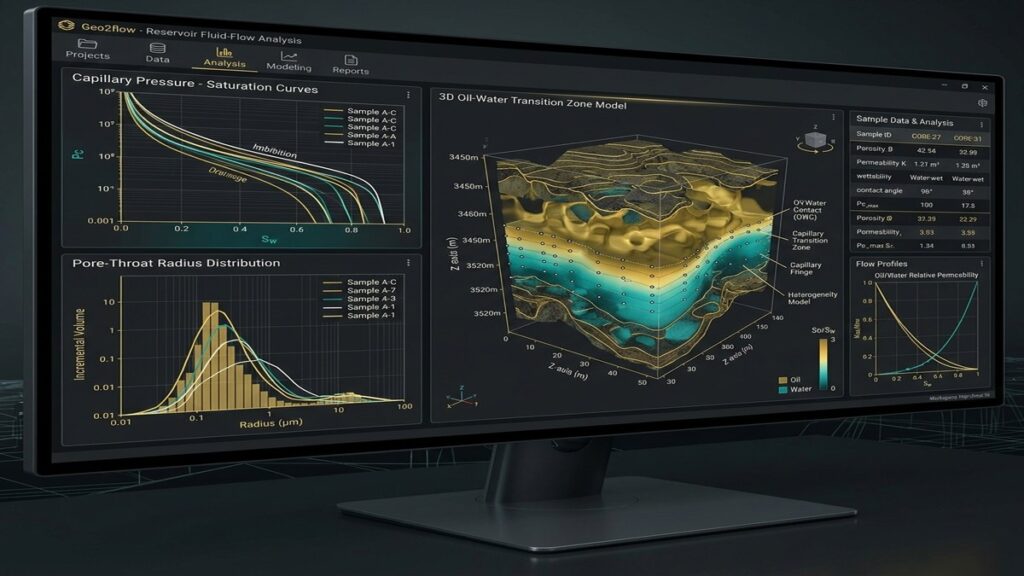
Reservoir engineers and simulation specialists frequently encounter complex fluid behaviors in challenging geological settings that demand specialized analytical tools. Geo2flow software provides an analytical modeling framework specifically designed for detailed capillary-pressure and fluid-flow analysis, proving particularly relevant for tight and unconventional formations where conventional simulation approaches may be insufficient. It offers focused insights into the nuanced dynamics of fluid distribution and movement driven by capillary forces.
This article explores Geo2flow’s core capabilities, specific applications in reservoir engineering workflows, and its unique position relative to full-physics numerical simulators. Understanding its analytical focus allows professionals to assess its fit for projects requiring in-depth analysis of capillary-pressure effects and post-stimulation fluid behavior in low-permeability reservoirs.
Need This Software?
Contact us to request the software and receive download and access information.
Key Facts
- Best for: Reservoir Engineer / Simulation Specialist
- Also compare: Schlumberger Eclipse, CMG
Understanding Geo2flow’s Core Capabilities for Reservoir Analysis
Geo2flow is an analytical modeling framework that integrates diverse data types to provide insights into fluid dynamics within porous media. Its design focuses on scenarios where capillary pressure significantly influences fluid distribution and movement.
Key Analytical Features
- Integrated Data Framework: The software supports the integration of petrophysical, geological, engineering, and geophysical data. This comprehensive data integration facilitates a holistic understanding of the reservoir system and its fluid characteristics.
- Capillary-Pressure and Fluid-Flow Analysis: A central capability of Geo2flow is its specialized focus on analyzing capillary-pressure-driven fluid behavior. This includes detailed examination of fluid flow characteristics within various porous media types, crucial for understanding multi-phase flow in complex pore networks.
- Tight and Unconventional Formation Expertise: The framework is adapted to address the unique challenges of tight and unconventional reservoirs. It is designed to model situations where traditional simulation approaches may face limitations due to complex rock-fluid interactions, low permeability, and significant capillary effects.
Applying Geo2flow in Specific Reservoir Engineering Workflows
The analytical strength of Geo2flow lends itself to particular applications within reservoir engineering, supporting decisions in critical operational phases, especially for unconventional assets.
Real-World Applications
- Flowback and Cleanup Analysis: One prominent application is the analysis of flowback and cleanup processes in multi-fractured horizontal wells following hydraulic fracturing operations. The software assists engineers in understanding fluid removal dynamics and optimizing production initiation from these complex systems, where injected fluids interact with the reservoir under capillary forces.
- Static Model Integration: Geo2flow is commonly used in conjunction with simplified geological models, such as those generated in Petrel, which serve as static model inputs for the analytical framework. This allows for a streamlined integration of geological interpretations into the fluid-flow analysis.
Geo2flow‘s analytical approach was referenced in a 2024 MDPI Energies journal study evaluating capillary-pressure correlations, including the Brooks and Corey model, for tight and ultra-tight gas formations, underscoring its relevance in current research and industry practice.
Geo2flow’s Differentiator: Analytical Focus vs. Numerical Simulation
When evaluating reservoir simulation tools, it is crucial for reservoir engineers and simulation specialists to distinguish between analytical and full-physics numerical approaches. Geo2flow stands out due to its specific analytical focus on capillary-pressure-driven fluid behavior.
Unlike full-physics numerical simulators, which solve complex partial differential equations across a discretized reservoir model, Geo2flow employs an analytical framework. This specialization makes it particularly effective for detailed, targeted analyses of phenomena such as post-frac flowback in tight and ultra-tight formations, where specific fluid mechanics governed by capillary forces are paramount. Its analytical nature can provide rapid insights into specific problems without the computational overhead of a full-field simulation.
How Geo2flow Fits Your Reservoir Engineering Workflow
For reservoir engineers and simulation specialists tasked with understanding the nuanced fluid dynamics of tight and unconventional reservoirs, particularly post-fracturing, Geo2flow offers a focused analytical solution. If your work requires deep insights into capillary-pressure effects, flowback performance, and cleanup processes in multi-fractured wells, this software can provide the specialized analysis needed, often complementing broader geological models or full-field numerical simulations. It is best suited when a detailed understanding of specific capillary-driven phenomena is the primary objective, rather than broad field-scale production forecasting.
| Feature Aspect | Geo2flow (Analytical Focus) | Numerical Simulators (e.g., Schlumberger Eclipse, CMG) |
|---|---|---|
| Core Methodology | Analytical modeling framework, focused on specific physics | Full-physics numerical simulation, solving PDEs across a grid |
| Primary Focus | Capillary-pressure and fluid-flow analysis in porous media, tight/unconventional formations | Comprehensive reservoir performance prediction, varied fluid flow scenarios, complex geology |
| Key Application Example | Flowback and cleanup analysis in multi-fractured horizontal wells post-hydraulic fracturing | Field-scale production forecasting, EOR studies, reservoir management over life cycle |
| Integration | Often used with simple geological model inputs (e.g., from Petrel) | Integrates directly with detailed geological models for full-field simulation |
Frequently Asked Questions About Geo2flow
What types of geological data can Geo2flow integrate?
Geo2flow is designed to integrate diverse data types including petrophysical, geological, engineering, and geophysical data. This allows for a comprehensive understanding of the reservoir system within its analytical framework.
How does Geo2flow specifically address fluid flow in tight formations?
Geo2flow addresses fluid flow in tight and unconventional formations by specifically focusing on capillary-pressure-driven fluid behavior. It is adapted to model the unique challenges of these low-permeability reservoirs, where rock-fluid interactions and capillary forces significantly influence fluid distribution and movement.
Can Geo2flow be used to optimize hydraulic fracturing designs?
Geo2flow primarily supports the analysis of fluid behavior *after* hydraulic fracturing, specifically in understanding flowback and cleanup processes in multi-fractured horizontal wells. While insights gained can inform future design strategies, its direct application is in post-fracture fluid dynamics analysis rather than the upfront optimization of fracturing designs themselves.
What are the primary outputs or results generated by Geo2flow?
Geo2flow generates insights into fluid dynamics, providing detailed examination of fluid flow characteristics within porous media, especially concerning capillary-pressure effects. This includes understanding fluid removal and production initiation from complex systems like multi-fractured wells during flowback and cleanup phases.
Is Geo2flow suitable for understanding post-stimulation well performance?
Yes, Geo2flow is particularly well-suited for understanding post-stimulation well performance. Its capabilities for flowback and cleanup analysis in multi-fractured horizontal wells are directly applicable to assessing how wells perform after hydraulic fracturing operations, especially regarding fluid recovery and initial production characteristics.
Need Access to This Software?
Need this software for your project? Contact us for download access, availability, and related information.
Conclusion
Geo2flow is a specialized analytical modeling framework that offers reservoir engineers and simulation specialists targeted capabilities for analyzing capillary-pressure and fluid-flow dynamics, especially in challenging tight and unconventional formations. Its focus on detailed fluid behavior post-fracturing and integration with various data types positions it as a valuable tool for gaining specific insights that complement broader numerical simulations. Discover how Geo2flow’s specialized analytical capabilities can address your specific reservoir engineering challenges by contacting petroleumsoftware.ir today.
Source: Source


Hello, we are evaluating Geo2flow for our reservoir engineering workflow. How can we request access and download the full setup?