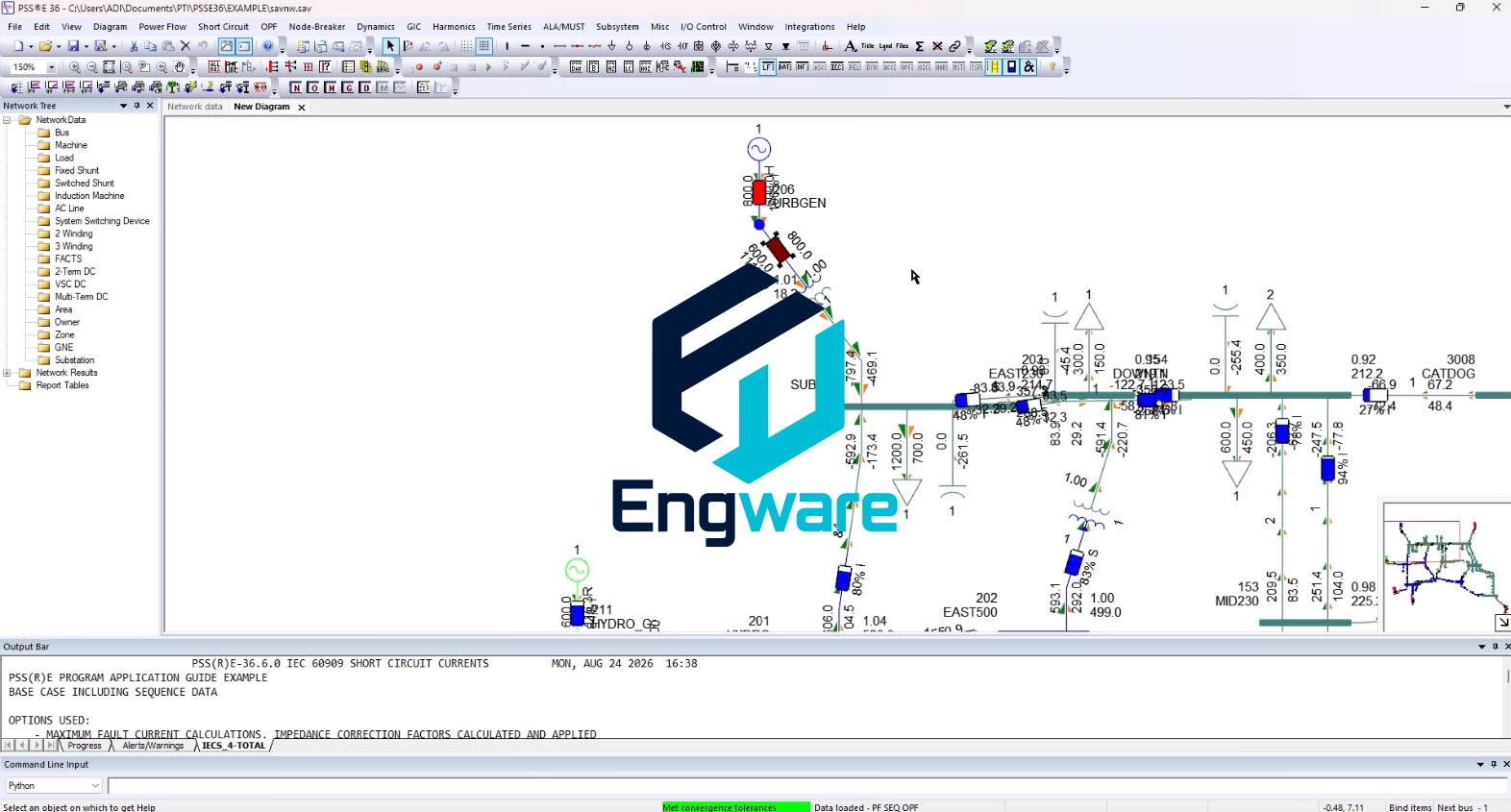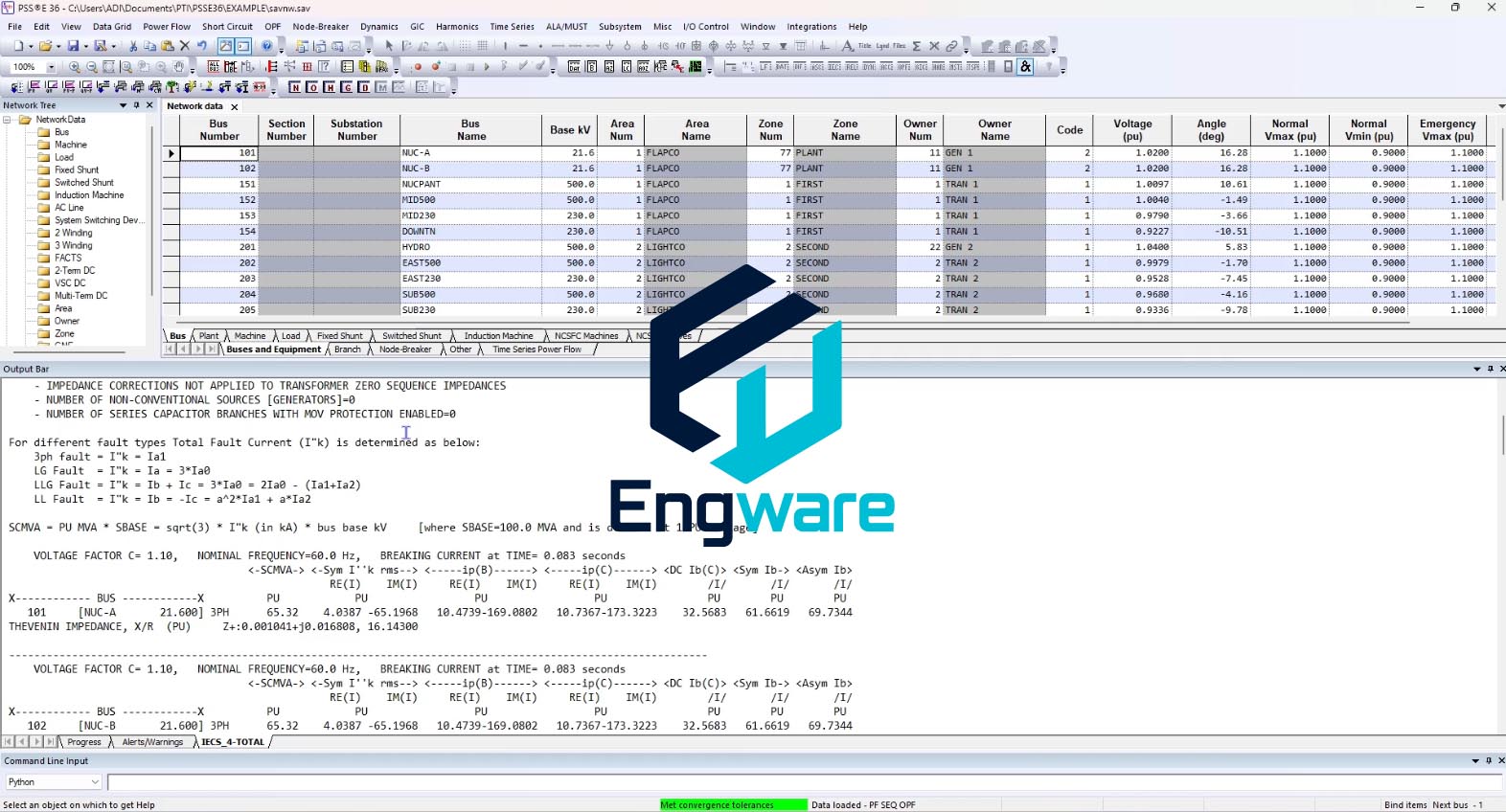
A transmission interconnection study needs more than a converged load flow. The planning team must agree which network case, equipment models, contingencies and dynamic controls will be accepted by the utility reviewing the submission. Siemens’ Gridscale X PSS E is a candidate when that study and model-exchange workflow is the central requirement. This research-based technical assessment uses official sources checked on November 7, 2026 UTC; we did not independently install or test the software.
Need This Software?
Contact us to request the software and receive download and access information.
The current Siemens product page markets it as Gridscale X PSS E and documents transmission planning, power flow, contingency and fault analysis, PV/QV studies, node-breaker modeling and dynamic simulation. PSS E remains a Siemens offering; the Gridscale X label should not be read as evidence of a different developer or an acquisition.
Pin the build before specifying the study
The public product page identifies 36.3.1 and its support for Intel oneAPI Toolkit 2025.1.0 IFX, while the version 36 offering remains available. Those sources establish documented version-36 capabilities, not the latest deliverable maintenance build. The 36.6 number in the earlier draft was not independently confirmed in an official release record reviewed here.
Siemens’ 2026 maintenance plan says version 36 will enter maintenance mode upon the planned release of 37, with limited fixes for up to six months after that major release. This is a conditional lifecycle statement, not proof that 37 has shipped. Ask Siemens which major/minor build is being delivered and its support end date, then record that baseline with every issued study.
Start from the network case and the required outputs
For a hypothetical generator interconnection, a defensible case would identify buses and topology, branch impedances and ratings, transformer data, generation and demand, voltage-control assumptions and the operating scenarios to evaluate. The project also needs a defined contingency list and acceptance limits. The software can analyze the supplied network; it cannot establish that an omitted outage or an assumed dispatch represents the grid connection agreement.
The documented Base package includes power flow, contingency analysis, PV/QV voltage stability, transmission reliability assessment, Python scripting, the GUI and contour plotting. Voltage profiles, network flows and contingency results answer steady-state planning questions. A converged case is a starting point for reviewing equipment loading and voltage criteria, rather than evidence that every relevant disturbance is acceptable.
Dynamic Simulation and Short-Circuit Analysis are included in the advertised Standard monthly package, alongside Line Properties; Advanced adds capabilities including OPF, GIC, Python RAS and Advanced Linear Analysis. Expert adds Harmonics and Time Series Power Flow. This package boundary matters: a base licence should not be assumed to include the dynamic, harmonic or time-series method named in a study specification.
For disturbance studies, the current product page documents built-in and user-defined models for generators, renewables, FACTS and controllers. Siemens’ linked dynamic-simulation sheet describes disturbance response and plotted output channels, but is dated December 2014. It is background on the workflow, not evidence of current build limits. Obtain the accepted OEM model, parameter set and validation basis for the present study instead of treating a library entry as confirmation of actual plant response.
Automation helps only when the model basis survives
Siemens documents a Python API on the current product page. That is a substantive reason to evaluate PSS E for repeatable case changes, contingency runs and result extraction. The useful acceptance demonstration is a script that changes an agreed parameter, runs the specified calculation, records warnings and extracts the governing result with its units and case identity. The reviewed page does not establish the exact Python runtime or API signatures for every build; those belong in the installation and API documentation for the delivered version.
Version 36 introduces version-independent dynamic-user-model DLLs and a source-model conversion tool, according to the version-specific page. This addresses a real maintenance issue for custom models, but does not remove the need to verify converted behavior, compiler support and dependencies. Keep a known reference case and have the model owner approve the migration before using converted controls in a submission.
For electromagnetic-transient questions, Siemens separately lists PSS E–PSCAD conversion and co-simulation extensions. Model exchange and hybrid simulation are explicit additional workflows; the existence of dynamic simulation in PSS E should not be taken as proof that it replaces the required EMT representation. Specify which signals, network equivalents and models must cross that boundary.
On-premise, hybrid cloud and licence rights are separate choices
The June 2026 On Premise Product Sheet describes electronic-download delivery, term/subscription licensing and order-defined modules. It lists fixed/movable individual and network arrangements, including borrowing under stated conditions, while the monthly offering is specifically restricted to a fixed physical PC with no VM installation. Apply the terms for the actual order, rather than extending one package’s deployment rights to another.
The same sheet distinguishes standard access up to 32 cores/logical processors from optional higher entitlements. This is a licensing metric, not a benchmark or a promise that a study will use every core efficiently. The current product page describes Hybrid Cloud as an optional on-demand extension for on-premise users and identifies North American availability from 36.2.0. It does not establish availability for every territory or turn the desktop product into an unrestricted browser service.
Siemens links a version-36 hardware, operating-system and privileges article, but that source required an authorized support login during this assessment. The exact supported Windows edition/build, memory, Python/compiler pairing, installation privileges and any VM configuration therefore need confirmation from the current installation manual. A successful installation on an unspecified machine is not a substitute for a supported configuration.
The June product sheet describes maintenance for supported versions and directs support to the Siemens PSS Customer Care Portal. It also distinguishes installation/operation support from engineering consulting or training. Confirm the service terms applicable to your order and the receiving utility’s required software version before purchasing; this assessment makes no claim that a public product page guarantees supply or support for a particular buyer.
Need Access to This Software?
Need this software for your project? Contact us for download access, availability, and related information.
Compare accepted models and study scope
DIgSILENT PowerFactory is a relevant alternative for generation, transmission, distribution and industrial network analysis, with documented scripting and interfacing. Compare the required study methods, accepted equipment models, exchange formats and automation path on the same case. Where a utility requires a particular PSS E model submission, matching that requirement is a concrete reason to shortlist PSS E. Where the project combines several network levels or already has an established alternative model library, evaluate the conversion and review effort before changing platforms.
For a broader electrical-system shortlist, see our ETAP technical assessment. If a network study identifies a cable constraint, the CYMCAP cable thermal-rating assessment addresses the installation-specific rating question. Cable thermal analysis complements the network study; neither that link nor a rating input proves an automatic interface with PSS E.
The evidence is strong for the documented PSS E workflow, version-36 package distinctions and public commercial terms. Confidence is limited for the latest build and its installation matrix. The practical next step is to obtain Siemens’ current release notes and supported configuration, then demonstrate one governing steady-state and, if required, dynamic case using the exact OEM models and package proposed for the project. Choose on that accepted deliverable and maintainable workflow, rather than on an unsupported claim of superior accuracy or speed.