Production engineers and well test analysts frequently encounter challenges in optimizing gas-lift operations, particularly during the critical unloading phase. Ensuring stable and efficient production requires tools that can accurately model the dynamic behavior of the well. This article provides a detailed overview of Weatherford DynaLift, a module within the Weatherford Field Office suite, designed to address these specific needs.
DynaLift offers a focused solution for the complexities of gas-lift, moving beyond static design considerations to provide insights into the transient behaviors that impact well performance. Its capabilities are particularly relevant for engineers seeking to minimize operational disruptions and enhance the longevity and productivity of gas-lifted wells.
Need This Software?
Contact us to request the software and receive download and access information.
Key Facts
- Best for: Production Engineer / Well Test Analyst
- Also compare: Baker Hughes Autograph PC, Schlumberger DesignRite ESP, GE Solutions ESP Design
Understanding Weatherford DynaLift for Gas-Lift Optimization
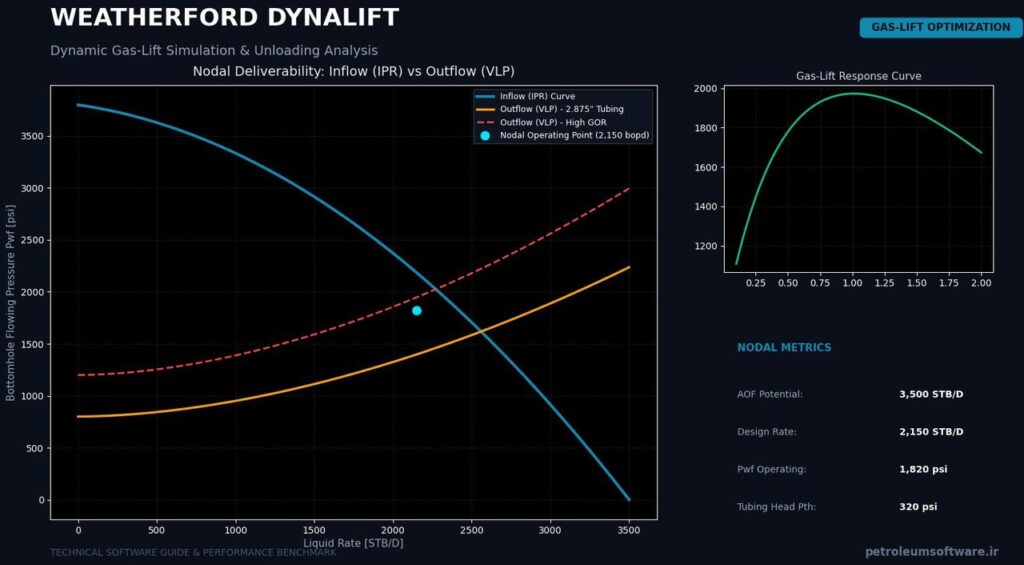
Weatherford DynaLift is engineered as a dynamic gas-lift optimization module. It provides engineers with capabilities to analyze and optimize the gas-lift unloading process, moving beyond traditional steady-state assumptions to offer a more accurate representation of well behavior.
Key Features for Production Engineers and Well Test Analysts
The software integrates specific functionalities to support comprehensive gas-lift design and analysis:
- Dynamic Gas-Lift Optimization: Focuses on the dynamic aspects of gas-lift, suitable for identifying and resolving operational issues.
- Transient Simulation of Unloading Process: Performs transient simulation of the gas-lift unloading process. This is vital for predicting how the well will behave as it transitions from initial conditions to stable production, allowing engineers to identify potential design issues proactively.
The DynaLift Differentiator: Transient Simulation
A significant distinction of Weatherford DynaLift lies in its explicit transient simulation approach to the gas-lift unloading process. Traditional gas-lift design workflows often rely on steady-state models, which can overlook critical dynamic behaviors that occur during unloading. By simulating these transient phenomena, DynaLift allows engineers to identify design issues before they lead to operational instability or inefficiencies in stable production.
For engineers, understanding the transient nature of gas-lift unloading is paramount to preventing unexpected operational disruptions and optimizing long-term well performance.
Integration within the Weatherford Field Office Suite
DynaLift operates as part of the broader Weatherford Field Office suite of production-optimization tools. It is designed to complement other modules, specifically WellFlo and ReO, enabling a more comprehensive approach to artificial-lift and network-level optimization. This integration ensures that gas-lift design can be considered within a wider production system context.
Related Software in Artificial Lift and Production Analysis
The field of artificial lift and production analysis features several specialized software tools. Here’s how Weatherford DynaLift stands in relation to other products in this category:
| Product Category | Related Products |
|---|---|
| Artificial Lift Design & Optimization | Baker Hughes Autograph PC |
| Artificial Lift Design & Optimization | Schlumberger DesignRite ESP |
| Artificial Lift Design & Optimization | GE Solutions ESP Design |
Frequently Asked Questions about Weatherford DynaLift
What specific problems does Weatherford DynaLift solve for production engineers?
Weatherford DynaLift is designed to help production engineers optimize gas-lift operations, particularly by accurately modeling the dynamic behavior of the well during the critical unloading phase. It assists in identifying and resolving operational issues and potential design flaws that can lead to instability or inefficiency in stable production.
How does transient simulation in DynaLift differ from traditional gas-lift design methods?
Traditional gas-lift design often relies on steady-state models, which may not fully capture the dynamic changes during the unloading process. DynaLift’s transient simulation explicitly models these time-dependent phenomena, allowing engineers to predict how a well will behave as it transitions from initial conditions to stable production, thereby revealing design issues that steady-state models might overlook.
Can DynaLift be used for existing gas-lift installations or only for new designs?
DynaLift provides capabilities for both design and analysis. Its focus on optimizing the gas-lift unloading process and identifying operational issues suggests utility for evaluating and enhancing existing gas-lift installations, as well as for designing new systems.
What types of data inputs are typically required for DynaLift simulations?
Specific data inputs for DynaLift simulations are not detailed in the provided information. However, typical gas-lift simulation software generally requires wellbore geometry, fluid properties, reservoir conditions, gas injection parameters, and downhole equipment specifications.
How does DynaLift integrate with other production optimization workflows?
DynaLift is an integral module within the Weatherford Field Office suite. It is designed to complement other tools in the suite, such as WellFlo and ReO, enabling a more comprehensive approach to artificial lift and overall network-level production optimization.
Need Access to This Software?
Need this software for your project? Contact us for download access, availability, and related information.
Conclusion
Weatherford DynaLift provides production engineers and well test analysts with a specialized tool for gas-lift optimization, distinguished by its transient simulation capabilities for the unloading process. By focusing on dynamic well behavior, it offers insights beyond traditional steady-state models, helping engineers proactively address operational challenges and improve long-term well performance. This makes it particularly suitable for professionals who require a deep understanding of gas-lift system dynamics for both design and troubleshooting. To explore how Weatherford DynaLift can enhance your gas-lift optimization strategies, submit an inquiry through the petroleumsoftware.ir request form to connect with an expert.