In the domain of well completion and hydraulic fracturing, precise simulation tools are critical for optimizing reservoir performance and maximizing hydrocarbon recovery. For completions and stimulation engineers, selecting the right software involves evaluating its core modeling capabilities, data integration prowess, and applicability to complex reservoir conditions.
Need This Software?
Contact us to request the software and receive download and access information.
This article reviews GOHFER, or Grid Oriented Hydraulic Fracture Extension Replicator, a specialized software designed for hydraulic fracture simulation, focusing on its unique shear/slip-based fracture geometry and comprehensive multi-disciplinary data integration.
Key Facts
- Category: Hydraulic Fracture Simulation Software
- Best for: Completions Engineer, Stimulation Engineer
- Also compare: Meyer MFrac, Fracpro, Schlumberger FracCADE
Understanding GOHFER: A Hydraulic Fracture Extension Replicator
GOHFER, which stands for Grid Oriented Hydraulic Fracture Extension Replicator, is a specialized software designed for hydraulic fracture simulation. Originally developed by Dr. Robert D. Barree and Barree & Associates LLC, it is now actively managed, sold, and supported by Halliburton Production Enhancement. GOHFER provides a planar 3D geometry fracture simulator equipped with a fully coupled fluid/solid transport simulator.
Core Simulation Mechanics
The foundation of GOHFER’s simulation lies in its finite-difference gridded solution, which explicitly accounts for shear/slip fracture geometry. This approach distinguishes it from simpler linear elastic models, allowing for a more nuanced representation of fracture propagation and behavior within the reservoir.
Integrated Workflow: A Multi-Disciplinary Approach
A key capability of GOHFER is its explicit integration of diverse input data from across multiple engineering and geoscience disciplines. This allows engineers to build a cohesive and comprehensive 3D reservoir/geomechanical model.
- Petrophysics: Incorporating rock properties and fluid saturations.
- Geology: Integrating structural and stratigraphic data.
- Geophysics: Utilizing seismic and other subsurface imaging data.
- Drilling: Accounting for wellbore trajectories and casing details.
- Reservoir Engineering: Applying reservoir characteristics and fluid dynamics.
- Completions Engineering: Incorporating stimulation treatment designs and parameters.
This integrated model is applicable for both conventional and unconventional reservoirs, providing a unified platform for fracture design and analysis.
Advanced Fracture Modeling Scenarios
GOHFER is equipped to model complex hydraulic fracturing operations, addressing challenges commonly encountered in modern oil and gas development.
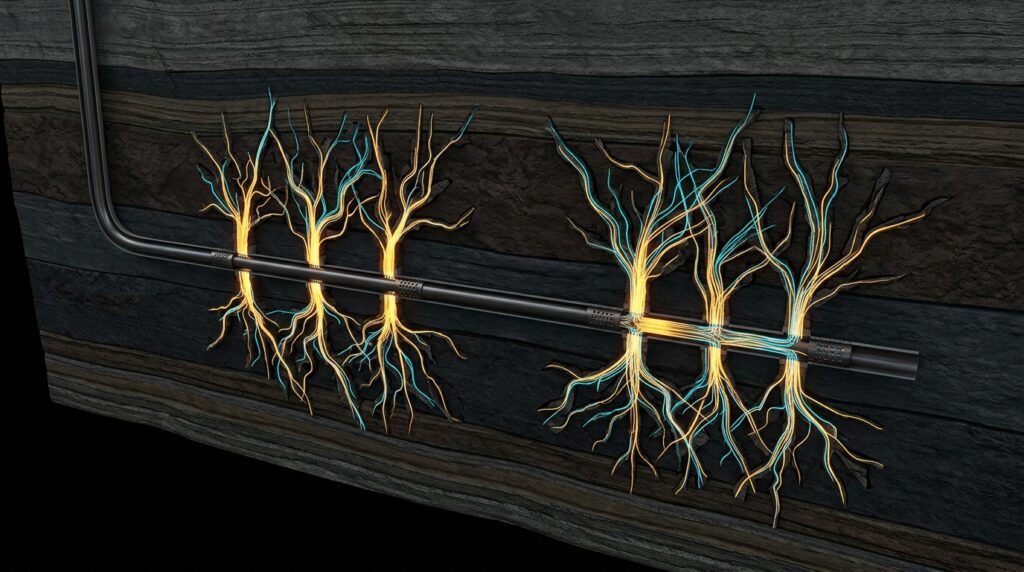
- 3D Complex Horizontal Fracturing: Simulating both longitudinal and transverse components of fractures in horizontal wells.
- Multi-Stage/Multi-Cluster Simulations: Supporting detailed analysis of plug-and-perf or ball-drop completion methods.
- Stress-Shadow Interference: Accurately modeling variable inter- and intra-stage stress-shadow effects, which are critical for optimizing cluster spacing and treatment sequencing.
Post-Frac Analysis with the GOHFER Production Module
Beyond initial fracture design, the GOHFER Production module extends the software’s utility into post-fracture performance analysis. This module incorporates research from Stimlab Inc. to address critical aspects of well productivity following stimulation.
Key features of the Production module include:
- Modeling post-frac cleanup processes.
- Simulating multiphase non-Darcy flow within the fracture and near-wellbore region.
- Accounting for proppant-crushing stress effects, which can impact long-term conductivity.
GOHFER’s Distinct Approach to Hydraulic Fracturing Simulation
The differentiation of GOHFER in the hydraulic fracturing software landscape stems from two primary aspects:
- Its explicit, multi-disciplinary data integration into a single coherent model.
- Its foundational assumption of shear/slip-based fracture geometry, rather than simpler linear-elastic models.
This distinct physical modeling approach contrasts with the P3D lumped models often utilized by some competing tools. For engineers evaluating simulation options on petroleumsoftware.ir, understanding these distinctions is key to selecting the most appropriate tool for their specific modeling requirements.
Halliburton, the current vendor of GOHFER, emphasizes the software’s capabilities, stating that it can provide “more than twice as much” data and results compared to its closest competitor, and has been rated most accurate by “almost a 4:1 margin.” These vendor-stated claims highlight the emphasis on detail and precision inherent in the GOHFER design.
Comparison with Alternatives in Fracture Simulation
In the realm of well completion, fracturing, and cementing, engineers have several tools at their disposal. Competing products in this category include Meyer MFrac, Fracpro, and Schlumberger FracCADE. While these tools also address aspects of hydraulic fracturing, GOHFER offers a distinct modeling methodology, particularly concerning its treatment of fracture geometry and multi-disciplinary data synthesis.
| Feature/Characteristic | GOHFER | Other P3D Lumped Models (e.g., MFrac, Fracpro) |
|---|---|---|
| Fracture Geometry Assumption | Shear/slip-based (finite-difference gridded solution) | Simple linear elastic (P3D lumped models) |
| Data Integration Scope | Explicitly integrates petrophysics, geology, geophysics, drilling, reservoir, completions into one 3D model | Typically less explicit multi-disciplinary integration in a single coherent model |
| Coupling | Fully coupled fluid/solid transport simulator | Varies by product |
Benefits for Completions and Stimulation Engineers
For completions and stimulation engineers, GOHFER offers several advantages:
- Enhanced Accuracy: The shear/slip fracture geometry model provides a more realistic representation of fracture propagation, leading to more accurate predictions.
- Holistic Design: Integrated data input across disciplines fosters a comprehensive understanding of reservoir response to fracturing.
- Optimized Operations: Detailed simulation of complex horizontal wells, multi-stage treatments, and stress-shadow effects allows for better design optimization and reduced operational risks.
- Improved Production Forecasting: The Production module helps in understanding post-frac well performance, contributing to better long-term production strategies.
By leveraging GOHFER, engineers can make data-driven decisions to design more effective hydraulic fracturing treatments, optimize well performance, and improve overall asset value.
FAQ
What types of reservoirs can GOHFER simulate hydraulic fracturing for?
GOHFER is suitable for simulating hydraulic fracturing operations in both conventional and unconventional reservoirs.
How does GOHFER account for complex 3D horizontal fracturing?
GOHFER is designed to simulate both longitudinal and transverse components of fractures in complex 3D horizontal wells.
What is the significance of GOHFER’s shear/slip fracture geometry modeling?
The shear/slip fracture geometry modeling in GOHFER, based on a finite-difference gridded solution, distinguishes it from simpler linear elastic models, enabling a more nuanced and realistic representation of fracture propagation and behavior.
Which engineering and geoscience disciplines does GOHFER integrate data from?
GOHFER explicitly integrates data from petrophysics, geology, geophysics, drilling, reservoir engineering, and completions engineering to build a comprehensive 3D reservoir/geomechanical model.
What capabilities does the GOHFER Production module offer for post-frac analysis?
The GOHFER Production module provides capabilities for modeling post-frac cleanup processes, simulating multiphase non-Darcy flow within the fracture and near-wellbore region, and accounting for proppant-crushing stress effects.
Need Access to This Software?
Need this software for your project? Contact us for download access, availability, and related information.
Conclusion
GOHFER is best suited for completions and stimulation engineers requiring a highly detailed and physically realistic simulation of hydraulic fracturing. Its unique shear/slip-based fracture geometry modeling and explicit multi-disciplinary data integration provide a comprehensive platform for optimizing fracture design and analyzing post-frac performance, especially in complex unconventional plays. To explore how GOHFER can enhance your hydraulic fracturing design and analysis workflows, submit an inquiry through petroleumsoftware.ir’s request form.