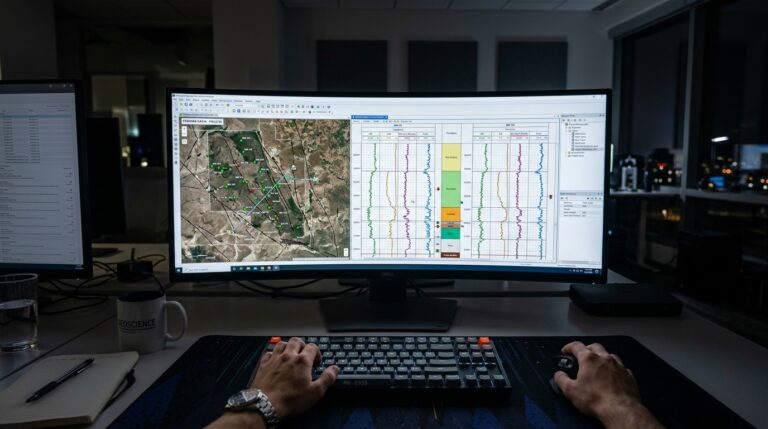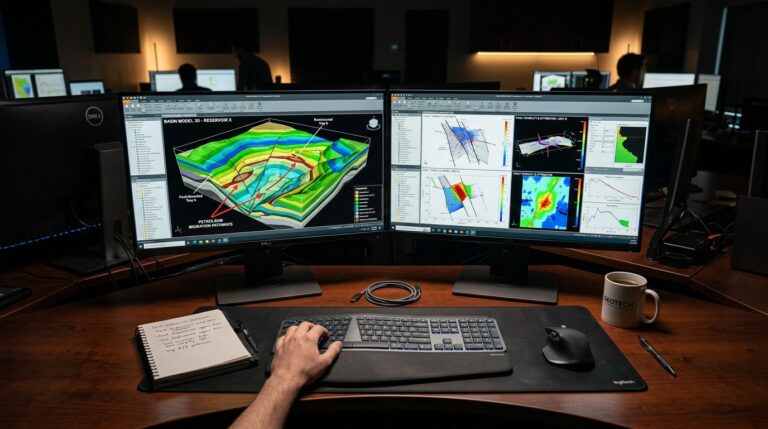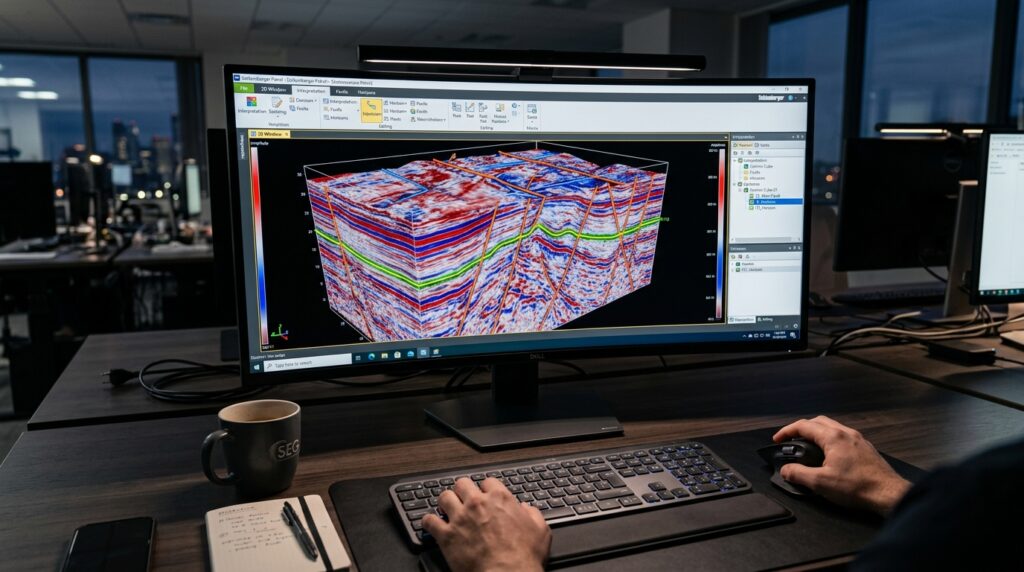
For geologists and geophysicists engaged in detailed subsurface analysis, selecting the right software is critical. dGB Earth Sciences OpendTect stands out as a robust platform for 3D seismic interpretation, seismic attribute analysis, and advanced machine learning applications. It combines a powerful, actively developed core with a uniquely open and extensible architecture, making it a versatile tool for various E&P workflows.
Need This Software?
Contact us to request the software and receive download and access information.
This article explores OpendTect’s capabilities and its distinctive approach to geoscience software, helping professionals determine if its open-source foundation and extensive plugin ecosystem align with their project requirements for accurate and efficient subsurface characterization.
Key Facts
- Category: Geology, Seismic Interpretation & Basin Modeling
- Best for: Geologist / Geophysicist
- Also compare: Geoteric, Eliis PaleoScan, CGG InsightEarth
Understanding dGB Earth Sciences OpendTect
dGB Earth Sciences OpendTect is a comprehensive software solution designed for geological and geophysical professionals. Developed by dGB Earth Sciences, it facilitates detailed analysis of seismic data through its robust interpretation environment. A key characteristic of OpendTect is its dual distribution model, offering a free open-source core alongside commercial “Pro” and plugin editions. This model fosters a dynamic ecosystem, allowing users to leverage core functionalities while having access to a wide array of specialized tools through an extensive plugin library.
Key Capabilities for Seismic Interpretation and Analysis
OpendTect provides a suite of features tailored for modern seismic interpretation challenges, integrating advanced analytical tools within a flexible framework.
Core 3D Seismic Interpretation
At its foundation, OpendTect offers a powerful environment for 3D seismic interpretation. This includes fundamental capabilities required by geologists and geophysicists to visualize, manipulate, and interpret seismic volumes effectively. Users can perform structural and stratigraphic interpretation, horizon picking, fault mapping, and other essential tasks necessary for building accurate subsurface models. The software supports the loading and display of various seismic data formats, allowing for efficient navigation through large 3D seismic cubes to identify key geological features and delineate subsurface structures. This core functionality provides the necessary framework for all subsequent advanced analyses.
Advanced Seismic Attribute Analysis
Beyond basic interpretation, OpendTect excels in seismic attribute analysis. It enables users to extract a wide range of attributes from seismic data, providing deeper insights into geological features, reservoir characteristics, and fluid distribution. This capability is crucial for identifying subtle geological anomalies, such as channels, reefs, or fracture zones, and enhancing the understanding of complex subsurface environments. The platform supports both conventional attributes (e.g., amplitude, frequency, phase) and advanced attribute generation (e.g., coherence, curvature, spectral decomposition, inversion attributes), aiding in detailed reservoir characterization and prospect evaluation. The workflow typically involves selecting a seismic volume, applying attribute algorithms, and then visualizing the results in 2D or 3D to reveal hidden patterns.
Machine Learning for Seismic Interpretation
OpendTect integrates machine learning (ML) capabilities directly into the interpretation workflow through specialized plugins. These ML-based interpretation plugins empower geoscientists to automate repetitive tasks, identify patterns, and enhance predictions for reservoir properties, facies classification, and subtle geological features. For instance, ML algorithms can be trained on interpreted horizons or wells to automatically pick similar features across entire seismic volumes, significantly reducing manual effort. They can also be used for advanced seismic facies classification, predicting rock types or fluid content based on attribute responses. The application of machine learning significantly improves the efficiency and accuracy of seismic data analysis, helping to uncover insights that might be challenging to detect with traditional methods and supporting data-driven decision-making.
The Extensible Plugin Architecture
A central tenet of OpendTect’s design is its open and extensible plugin architecture. This framework allows for continuous enhancement and specialization of the software through a rich ecosystem of plugins. These plugins, developed by dGB Earth Sciences and third parties, extend OpendTect’s functionality to cover a broader spectrum of geoscience applications, including seismic attribute analysis, sequence stratigraphy, quantitative interpretation, and bespoke processing workflows. This open architecture includes robust support for machine learning plugins, fostering innovation and providing users with access to cutting-edge analytical tools. The modular nature allows users to tailor their OpendTect environment by adding only the specific functionalities required for their project needs, thereby maintaining a lean yet powerful software setup.
The Advantage of an Open-Source Foundation
OpendTect’s foundation as an open-source core with commercial plugin tiers represents a significant differentiator in the petroleum and energy engineering software landscape. This model provides a uniquely low-cost entry point for exploration and academic use, making advanced seismic interpretation tools accessible to a wider community. The open-source nature promotes transparency, allowing users to understand the underlying algorithms and fostering community-driven development and adoption. Its long, continuous release history and strong adoption within academic and research communities further underscore its reliability and utility as a dynamic platform for geoscience innovation. This approach ensures that the core framework remains robust and widely supported, while specialized, commercially developed tools can integrate seamlessly to offer advanced functionality.
OpendTect’s Differentiators in the Market
In a category dominated by proprietary platforms, OpendTect distinguishes itself by being the only major product built upon an open-source core. This unique characteristic provides several advantages:
- Low-Cost Entry: The free open-source core allows users to begin with essential functionalities for seismic visualization and basic interpretation without initial investment.
- Flexible Plugin Ecosystem: The open architecture supports a diverse range of plugins, including those from third parties and specialized machine learning tools, which extends functionality in ways proprietary systems often cannot replicate. This includes both commercial and community-contributed plugins.
- Community and Research Focus: Its open nature has fostered significant adoption in academic and research sectors, contributing to continuous development and a robust user community that shares knowledge and develops custom solutions.
- Extensive Customization: The plugin-extensible architecture offers unparalleled flexibility for users to tailor the software to their specific workflows, integrate proprietary algorithms, and adapt to evolving research and industry needs.
Comparison with Related Software
When considering software for geology, seismic interpretation, and basin modeling, it’s useful to understand how dGB Earth Sciences OpendTect compares to other tools in the category. The table below outlines OpendTect against some related products available through petroleumsoftware.ir.
| Product | Category | Key Distinction / Focus |
|---|---|---|
| dGB Earth Sciences OpendTect | Geology, Seismic Interpretation & Basin Modeling | Open-source core with extensive commercial/third-party plugin ecosystem, strong ML integration |
| Geoteric | Geology, Seismic Interpretation & Basin Modeling | Specialized commercial platform |
| Eliis PaleoScan | Geology, Seismic Interpretation & Basin Modeling | Specialized commercial platform |
| CGG InsightEarth | Geology, Seismic Interpretation & Basin Modeling | Specialized commercial platform |
Who Benefits Most from OpendTect?
dGB Earth Sciences OpendTect is particularly well-suited for geologists and geophysicists who require a powerful, flexible, and cost-effective solution for advanced 3D seismic interpretation and analysis. It is an ideal choice for professionals involved in detailed reservoir characterization, complex structural and stratigraphic studies, and those looking to leverage machine learning techniques in their interpretation workflows. Its open-source foundation also makes it highly attractive to academic researchers and smaller exploration teams seeking robust capabilities without the initial high investment of fully proprietary systems.
FAQ
What types of seismic data can OpendTect process?
OpendTect is designed to process 3D seismic data volumes, supporting essential interpretation tasks such as structural and stratigraphic interpretation, horizon picking, and fault mapping.
How does OpendTect support advanced attribute analysis workflows?
OpendTect provides extensive capabilities for seismic attribute analysis, allowing users to extract a wide range of attributes from seismic data to gain deeper insights into geological features and reservoir characteristics for detailed reservoir characterization.
Can OpendTect be integrated with other geoscience software tools?
The core information provided does not specify direct integration with other geoscience software tools, but its extensible plugin architecture suggests a flexible framework that can be adapted to various workflows and potentially interact with other systems through data exchange formats.
What role does machine learning play in OpendTect’s interpretation capabilities?
Machine learning (ML) is integrated into OpendTect through specialized plugins, enabling geoscientists to automate repetitive tasks, identify complex patterns, and enhance predictions for reservoir properties, facies classification, and subtle geological features, thereby improving efficiency and accuracy.
Is OpendTect suitable for both commercial E&P and academic research applications?
Yes, OpendTect’s dual distribution model, with a free open-source core and commercial plugin editions, makes it suitable for both commercial E&P activities and academic research, offering a low-cost entry point while providing access to advanced tools.
Need Access to This Software?
Need this software for your project? Contact us for download access, availability, and related information.
Conclusion
dGB Earth Sciences OpendTect offers geologists and geophysicists a highly capable and adaptable platform for 3D seismic interpretation, advanced attribute analysis, and the integration of machine learning workflows. Its unique open-source core, combined with a versatile plugin architecture, positions it as a flexible solution for professionals seeking powerful tools without the constraints of fully proprietary systems. To explore how dGB Earth Sciences OpendTect can enhance your seismic interpretation and analysis workflows, submit an inquiry through the petroleumsoftware.ir request form.