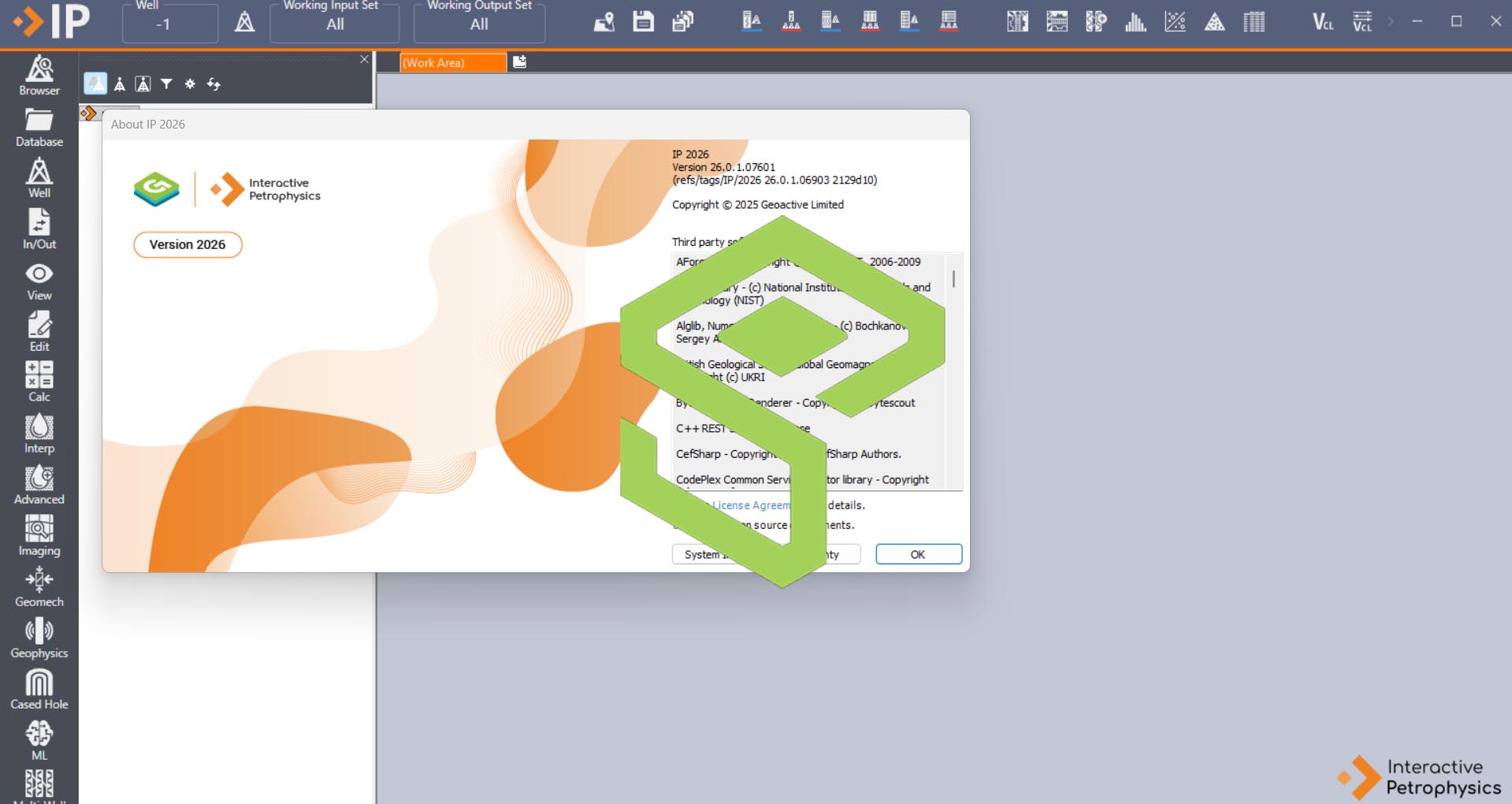
For petrophysicists and well log analysts, accurately characterizing subsurface reservoirs is fundamental to hydrocarbon exploration and production. The quality of formation evaluation directly impacts drilling decisions, reserve estimations, and field development strategies. Selecting software that provides robust tools for interpreting complex well log data, while also addressing inherent uncertainties, is a critical professional requirement.
Need This Software?
Contact us to request the software and receive download and access information.
Interactive Petrophysics (IP) software offers a dedicated desktop environment designed to meet these challenges. It provides comprehensive capabilities for petrophysical interpretation, from basic calculations to advanced analyses, with integrated features for quantifying uncertainty. This article explores the core functionalities of Interactive Petrophysics IP, highlighting its utility for detailed log analysis and reservoir characterization workflows.
Key Facts
- Category: Petrophysics Software
- Best for: Petrophysicist / Well Log Analyst
- Also compare: SLB Techlog, GeoSoftware PowerLog
Understanding Interactive Petrophysics IP
Interactive Petrophysics IP offers a robust environment for interpreting well log data, from fundamental petrophysical properties to advanced reservoir characterization. It is developed by Geoactive Limited and is recognized for its broad feature set within a standalone desktop application, providing an accessible yet powerful platform for a wide spectrum of petrophysical challenges.
Core Petrophysical Capabilities
The software integrates a suite of tools for detailed formation evaluation and interpretation, supporting a wide range of analytical needs.
Deterministic Analysis for Reservoir Properties
Interactive Petrophysics IP provides capabilities for deterministic analysis of key reservoir parameters, which are fundamental to understanding subsurface geology.
- Clay-Volume Determination: Tools for accurately calculating clay volume from various log inputs, essential for shale correction and reservoir quality assessment. Accurate clay volume is foundational for correcting other log responses and quantifying reservoir net-to-gross.
- Porosity Evaluation: Features for deriving porosity, integrating data from multiple log types to provide a comprehensive view of formation storage capacity. By integrating various porosity logs, the software helps mitigate ambiguities that may arise from single-source measurements.
- Saturation Analysis: Functionality for water and hydrocarbon saturation calculations, critical for estimating reserves and production potential. Precise saturation analysis is a prerequisite for reliable hydrocarbon-in-place estimations and economic evaluations.
Advanced Log Interpretation Workflows
Beyond standard analyses, Interactive Petrophysics IP extends into specialized interpretation techniques that leverage advanced logging data.
- NMR Interpretation: Dedicated modules for Nuclear Magnetic Resonance (NMR) log processing and interpretation, providing insights into pore size distribution, fluid typing, and permeability estimation. This includes processing T2 distributions and applying models to derive effective porosity, movable fluids, and irreducible water saturation.
- Borehole-Image Analysis: Tools for the interpretation of borehole image logs, enabling detailed fracture analysis, sedimentological studies, and structural interpretations. Such interpretations are critical for understanding reservoir heterogeneity, identifying permeable zones, and optimizing well placement.
- Cased-Hole Interpretation: Capabilities for evaluating formations through casing, supporting reservoir surveillance and mature field development decisions. These analyses are instrumental in monitoring fluid contacts, evaluating remaining hydrocarbon potential, and assessing injection effectiveness in mature fields.
Uncertainty and Risk Assessment
A significant aspect of petrophysical interpretation is quantifying the inherent uncertainties in data and models. Interactive Petrophysics IP addresses this through advanced statistical methods.
- Monte Carlo Uncertainty Analysis: Built-in functionality to perform Monte Carlo simulations, allowing petrophysicists to assess the range and probability of calculated reservoir parameters, thereby quantifying uncertainty in their interpretations. By propagating uncertainties from input parameters through the petrophysical model, engineers can generate probability density functions for key reservoir properties, offering a probabilistic view of outcomes.
Specialized Geoscientific Workflows
The software also incorporates workflows that bridge petrophysics with other geoscience disciplines.
- Geomechanics Workflows: Tools to integrate petrophysical data with geomechanical models, crucial for wellbore stability analysis, hydraulic fracturing design, and production optimization. The integration facilitates better understanding of rock mechanical properties, which is vital for preventing wellbore collapse and optimizing stimulation treatments.
- Rock-Physics Workflows: Capabilities to build and apply rock physics models, linking seismic attributes to reservoir properties and enhancing seismic interpretation. This integration supports quantitative interpretation of seismic data, allowing for more informed decisions on reservoir quality and fluid distribution.
Extensibility for Custom Solutions
Recognizing the need for customization, Interactive Petrophysics IP is designed to be adaptable to specific project requirements.
- Python Extensibility: Support for Python scripting, enabling users to develop custom algorithms, automate workflows, and integrate with other data sources. This allows for integration with machine learning libraries, external databases, or proprietary algorithms, extending the software’s analytical reach.
- Custom-Module Development: The ability to develop and integrate custom modules, allowing petrophysicists to extend the software’s functionality to address unique challenges or proprietary methods. This flexibility supports specialized research, proprietary workflows, or the adaptation of regional geological models within the software’s framework.
Differentiator: A Standalone Desktop Approach
Interactive Petrophysics IP distinguishes itself by providing a comprehensive desktop petrophysics workflow with built-in uncertainty analysis, without requiring the broader enterprise software stacks often associated with some competing tools. This modular approach allows users to focus on petrophysical tasks efficiently.
Interactive Petrophysics IP offers a complete desktop environment for advanced well log analysis, emphasizing detailed interpretation and uncertainty quantification without the need for an extensive enterprise infrastructure.
Product Comparison Overview
To help petrophysicists evaluate how Interactive Petrophysics IP fits into the broader software landscape, the table below highlights its approach compared to other commonly used solutions in the market. This comparison focuses on workflow philosophy and key advantages.
| Feature/Aspect | Interactive Petrophysics IP | Typical Enterprise Alternatives (e.g., SLB Techlog, GeoSoftware PowerLog, Aspen Geolog) |
|---|---|---|
| Workflow Focus | Broad desktop petrophysics workflow with modular licensing for focused analysis. | Often integrated into larger, multi-disciplinary enterprise platforms. |
| Uncertainty Analysis | Built-in Monte Carlo uncertainty analysis as a core feature. | Uncertainty analysis capabilities may vary, sometimes requiring additional modules or external tools. |
| Enterprise Stack Requirement | Designed as a direct, standalone alternative; does not require integration with wider enterprise stacks. | Often part of a larger vendor ecosystem, potentially requiring other modules or data management solutions. |
| Extensibility | Supports Python scripting and custom-module development for tailored solutions. | Extensibility options vary by vendor and product line, often within proprietary frameworks. |
Who Benefits from Interactive Petrophysics IP?
This software is particularly suited for petrophysicists and well log analysts who require a powerful, dedicated tool for detailed formation evaluation. Its comprehensive feature set, coupled with integrated uncertainty analysis and extensibility, supports both routine and specialized interpretations without mandating a larger IT footprint.
FAQ
What types of well log data can be analyzed by advanced petrophysics software?
Advanced petrophysics software like Interactive Petrophysics IP can analyze a wide range of well log data, including conventional logs for clay volume, porosity, and saturation. It also supports specialized data such as Nuclear Magnetic Resonance (NMR) logs and borehole image logs, as well as data from cased-hole logging for reservoir surveillance.
How does deterministic petrophysical analysis differ from probabilistic methods?
Deterministic petrophysical analysis calculates reservoir properties using fixed equations and input parameters derived directly from log measurements, yielding single-value results. Probabilistic methods, such as Monte Carlo uncertainty analysis available in Interactive Petrophysics IP, account for the variability and uncertainty in input parameters to produce a range of possible outcomes and their probabilities, providing a more comprehensive risk assessment.
What role does uncertainty analysis play in accurate reservoir characterization?
Uncertainty analysis is crucial in accurate reservoir characterization because it quantifies the inherent variability and imprecision in input data and interpretation models. By using methods like Monte Carlo simulations, engineers can understand the range of potential reservoir properties, leading to more robust reserve estimates, better drilling decisions, and more reliable field development plans.
Can petrophysics software integrate with geomechanics and rock physics workflows?
Yes, petrophysics software such as Interactive Petrophysics IP is designed with capabilities that bridge petrophysics with other geoscience disciplines. It includes tools for integrating petrophysical data with geomechanical models for wellbore stability and hydraulic fracturing design, as well as rock physics workflows for linking seismic data to reservoir properties.
What are the benefits of extensibility features like Python scripting in petrophysical interpretation?
Extensibility features like Python scripting in petrophysical interpretation provide significant benefits by allowing users to customize and automate their workflows. This enables the development of custom algorithms, integration with external data sources, and the creation of proprietary interpretation modules, adapting the software to unique project requirements and enhancing analytical capabilities beyond standard functionalities.
Need Access to This Software?
Need this software for your project? Contact us for download access, availability, and related information.
Conclusion
Interactive Petrophysics IP is a well-suited solution for petrophysicists and well log analysts seeking a powerful, dedicated desktop tool for comprehensive formation evaluation. Its integrated approach to petrophysical interpretation, combined with robust uncertainty analysis capabilities and extensibility, provides a compelling alternative to enterprise-stack solutions, allowing for focused, detailed subsurface characterization. To learn more about the specific capabilities of Interactive Petrophysics IP and discuss its fit for your projects, reach out to us via the inquiry form on petroleumsoftware.ir.
Source: Learn more directly from the official Geoactive product page.