
For reservoir and production engineers, effective surveillance of existing assets is crucial for maximizing recovery and operational efficiency. Landmark DSS software, or Dynamic Surveillance System, provides specialized capabilities for monitoring and diagnosing well and reservoir performance. This article details its core features and its distinct role in the petroleum engineering software landscape, helping you determine if it aligns with your workflow for optimizing current production and identifying anomalies.
Need This Software?
Contact us to request the software and receive download and access information.
Understanding the actual performance of producing wells and reservoirs is paramount for maintaining asset health and identifying opportunities for intervention. Landmark DSS offers a comprehensive suite of tools specifically engineered to support these diagnostic and surveillance activities, enabling engineers to analyze real-time and historical data to make informed operational decisions and improve asset profitability.
Key Facts
- Category: Production Surveillance
- Best for: Reservoir Engineer / Simulation Specialist
- Also compare: Nexus VIP, PetroleumSolutions Waterdrive
Understanding Landmark DSS: A Focus on Production Surveillance
Landmark DSS is designed to empower reservoir and production engineers in two primary areas: optimizing existing production and identifying replaceable proven reserves within an operational field. This involves the systematic collection, analysis, and visualization of dynamic field data to diagnose performance issues and uncover opportunities for improved recovery. Developed by Landmark (Halliburton), it historically integrates with the foundational Landmark OpenWorks data model, ensuring a cohesive approach to reservoir data management and facilitating access to a wide range of subsurface information.
The system’s emphasis is on understanding the current state and historical trends of a producing asset, providing the tools necessary to move beyond reactive problem-solving. By continuously monitoring key parameters, DSS helps engineers proactively address performance declines, identify anomalous behavior, and evaluate the effectiveness of production enhancement initiatives. This operational focus distinguishes it from software primarily used for long-term predictive modeling.
Key Capabilities of Landmark DSS
Well and Reservoir Performance Monitoring
DSS continuously monitors crucial well performance indicators, providing engineers with a detailed view of production dynamics across an entire field or individual wells. This capability supports both routine surveillance and targeted diagnostic investigations. This includes:
- Production and injection rates, tracking fluid movement and reservoir response over time.
- Pressures, including bottomhole, wellhead, and reservoir pressures, for understanding reservoir energy and fluid flow.
- Artificial-lift conditions, enabling the assessment of pump efficiency, gas lift optimization, and overall lift system health.
- Mechanical-failure trends, helping anticipate equipment failures and plan preventative maintenance, minimizing downtime and production losses.
The system connects seamlessly to standard industry databases, including Microsoft SQL Server, Oracle, and Sybase, facilitating integration with existing data infrastructure. This robust connectivity ensures that engineers can access and leverage a wide array of operational data, supporting comprehensive and data-driven analyses.
Dynamic Visualization for Anomaly Detection
To aid in the search for anomalous reservoir behavior, Landmark DSS offers dynamic visualization tools. These tools are critical for quickly identifying deviations from expected performance or trends that might indicate an underlying issue or an untapped opportunity. Engineers can leverage dynamic bubble, pie, and contour mapping to quickly identify patterns and deviations across a field. Bubble maps can represent well performance metrics such as production rates, with bubble size indicating magnitude, while pie charts at well locations can show fluid compositions. Contour maps provide spatial representations of pressure or saturation changes across the reservoir, highlighting areas of concern or interest. These visualizations allow for an intuitive understanding of complex data sets, enabling rapid identification of underperforming wells, breakthroughs, or areas requiring further investigation.
Structural and Completion Relationship Analysis
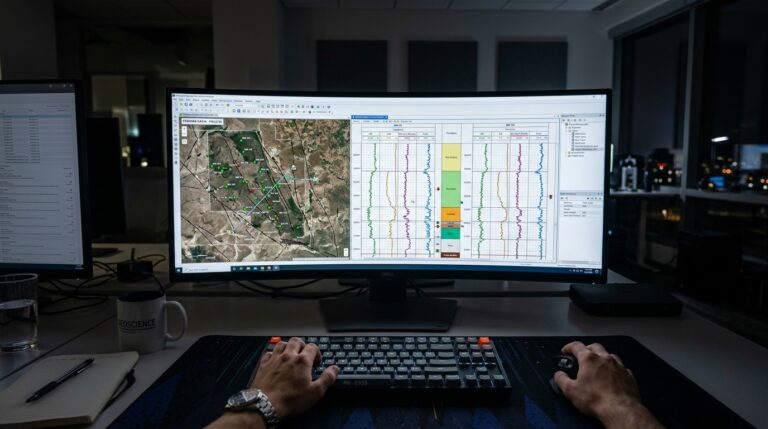
Understanding the subsurface context is vital for accurate diagnosis of well and reservoir performance. DSS provides cross-section capabilities that enable engineers to identify completion and structural relationships between wells. This analysis utilizes wellbore, log, and zone data, offering comprehensive insights into reservoir architecture and how completions interact with specific geological layers. By visualizing these relationships in cross-section, engineers can better understand fluid flow paths, identify potential communication issues between wells, and evaluate the effectiveness of their completion designs. This geological and wellbore context is essential for accurately interpreting dynamic production data and developing effective intervention strategies.
The Landmark DSS Differentiator: Surveillance, Not Prediction
A key distinction of Landmark DSS within the reservoir engineering software ecosystem is its role as a production-surveillance and anomaly-detection layer. Unlike forward-predictive simulators such as Nexus/VIP or Eclipse, DSS is purpose-built to monitor and diagnose existing well and reservoir behavior. Its strength lies in understanding “what is happening now” and “why,” rather than forecasting future development scenarios. While predictive simulators are crucial for evaluating development plans and long-term reservoir performance, DSS excels at providing immediate diagnostic insights into current operations. This makes it a critical tool for engineers focused on immediate operational optimization, issue resolution, and short-to-medium term asset management, complementing the long-term strategic planning enabled by simulation.
Integrating DSS into Your Reservoir Workflow
By providing direct diagnostic insights into current operations, Landmark DSS complements traditional reservoir simulation by focusing on the active phase of production. Its capabilities allow engineers to conduct continuous surveillance, which is a fundamental aspect of effective reservoir management. This enables engineers to move beyond reactive problem-solving, leveraging its capabilities to proactively identify and address performance bottlenecks, such as water breakthrough, declining artificial lift efficiency, or formation damage. The ability to quickly pinpoint anomalies and understand their root causes facilitates timely interventions, contributing directly to the overall efficiency of reservoir management and maximizing hydrocarbon recovery. Integrating DSS into the daily workflow means engineers have constant access to actionable intelligence, supporting iterative optimization loops and enhancing decision-making for ongoing asset operations.
Related and Competing Software Solutions
While Landmark DSS focuses on surveillance and anomaly detection, other tools in the market address different aspects of reservoir engineering:
| Product Name | Category / Primary Function |
|---|---|
| Nexus VIP | Reservoir Simulation |
| PetroleumSolutions Waterdrive | Reservoir Simulation |
FAQ
What is the primary function of Landmark DSS software?
The primary function of Landmark DSS software is to provide production surveillance and anomaly detection capabilities for reservoir and production engineers. It focuses on monitoring, diagnosing, and optimizing the performance of existing wells and reservoirs to maximize current production and identify replaceable proven reserves.
How does Landmark DSS help optimize existing production?
Landmark DSS helps optimize existing production by continuously monitoring key well and reservoir performance indicators, providing dynamic visualization tools for anomaly detection, and enabling structural and completion relationship analysis. This allows engineers to identify performance issues, understand their causes, and implement timely interventions to improve operational efficiency and recovery.
What types of well performance indicators can be monitored using DSS?
DSS can monitor various crucial well performance indicators including production and injection rates, pressures (e.g., bottomhole, wellhead), artificial-lift conditions, and mechanical-failure trends. These data points provide a comprehensive view of well health and reservoir behavior.
How does DSS integrate with existing data systems?
Landmark DSS integrates with existing data systems by connecting seamlessly to standard industry databases such as Microsoft SQL Server, Oracle, and Sybase. It also historically integrates with the foundational Landmark OpenWorks data model, ensuring a cohesive approach to reservoir data management.
Is Landmark DSS a predictive reservoir simulator?
No, Landmark DSS is not a predictive reservoir simulator. It is purpose-built as a production-surveillance and anomaly-detection layer designed to monitor and diagnose existing well and reservoir behavior (“what is happening now” and “why”), rather than forecasting future development scenarios.
Need Access to This Software?
Need this software for your project? Contact us for download access, availability, and related information.
Conclusion
Landmark DSS stands as a dedicated solution for reservoir and production engineers prioritizing the optimization and diagnostic analysis of existing assets. Its focus on dynamic surveillance, anomaly detection, and robust data integration provides the insights needed to maximize current production and identify untapped reserves. For those requiring a powerful tool to understand and react to real-time reservoir behavior, DSS offers a precise fit. To explore how Landmark DSS can enhance your reservoir surveillance strategies, submit an inquiry through our request form for detailed information.
Source: Source

Greetings, does Landmark DSS support Windows 11 64-bit systems?