ETAP is most compelling when an electrical team wants one governed network model to carry a project from the single-line diagram into load flow, fault, protection, arc-flash and dynamic studies—and potentially onward to operational monitoring. That continuity is more consequential than the sheer number of modules. It can reduce model re-entry, but it also makes data ownership, module scope and study QA central to the buying decision.
Need This Software?
Contact us to request the software and receive download and access information.
This is a research-based technical assessment of ETAP 2026, prepared from current ETAP and Schneider Electric product, release, support, licensing and system documentation. We did not run the software or reproduce its calculations, so vendor claims about accuracy, productivity and ease of use are not treated as independently verified results. The information was checked on 7 November 2026.
What ETAP 2026 is—and who owns it now
The current release page identifies ETAP 2026.0.1C Commercial / High Impact Edition as the latest commercial release. ETAP’s official release page organizes the 2026 changes around modeling, safety and protection, dynamics and transients, renewable integration, data exchange, operations and cybersecurity. The company’s support table lists commercial versions 26.0.0C through 22.5.0C as supported for technical inquiries, library support, upward project conversion and activation-code requests.
ETAP remains the product and operating brand of Operation Technology, Inc., but it sits within Schneider Electric’s software portfolio. ETAP describes itself as an independent software vendor within that portfolio, while Schneider Electric’s 2026 announcement identifies ETAP as part of its software solutions following the acquisition. In practice, buyers should treat ETAP as an actively developed Schneider Electric group product that continues to be sold and supported under the ETAP name.
The single-line diagram is the working model, not just a drawing
An ETAP study begins with the electrical network model: buses, sources, transformers, cables, motors, generators, protective devices, loads and their operating states. The intelligent single-line diagram and multidimensional database are meant to keep equipment data, topology, study configurations and results connected. That matters because the same feeder or protective device can appear in several calculations without being recreated for each one.
The practical workflow usually moves through five engineering questions:
- Is the model complete enough for the decision? Import or enter ratings, impedances, cable data, motor characteristics, protection settings and operating scenarios, then resolve missing or conflicting equipment records.
- Does the network operate within steady-state limits? Load-flow and voltage-drop studies establish bus voltages, branch currents, power factors, losses and loading under defined conditions. ETAP documents these outputs on its load-flow product page.
- Can equipment withstand credible faults? Short-circuit calculations feed equipment-duty checks and protection studies. The applicable ANSI/IEEE or IEC method, fault assumptions and equipment library data must be stated in the study basis.
- Will protection clear selectively and safely? Time-current curves, device settings, sequence-of-operation checks and arc-flash calculations connect the network model to protection decisions. A model result does not replace field verification of settings, labels, device condition or working distance.
- What happens during disturbances and changing operating states? Motor acceleration, transient stability, harmonics, contingency and time-series studies extend the same network into dynamic or scenario-based analysis when the licensed modules and input data support them.
The model also has to fit the wider asset-information chain. ETAP can exchange data with engineering and operational systems, but an electrical digital twin is not a substitute for multidiscipline plant design or reliability modeling. Our articles on AVEVA Unified Engineering and DNV Maros show two adjacent workflows where electrical results may be inputs, not the whole decision model.
Breadth is useful only when the module boundary is clear
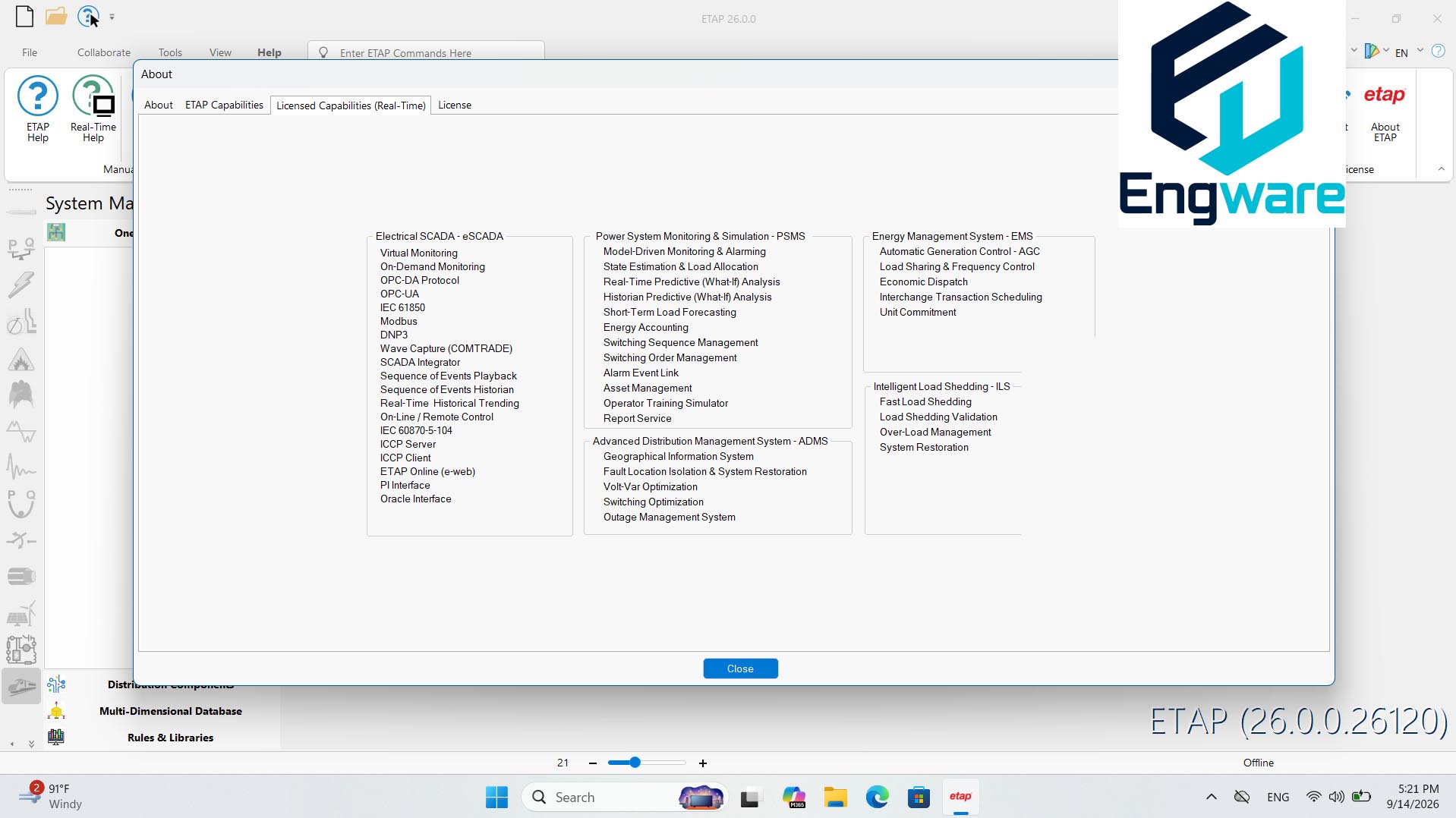
ETAP’s current analysis and optimization portfolio spans AC and DC load flow, short circuit, arc flash, motor starting, dynamics, cable systems, renewables, optimization and related applications. The wider product catalogue adds protection automation, transmission and distribution functions, geospatial modeling, SCADA-facing tools, APIs and operational products.
That breadth should not be read as a promise that every function is included in every quotation. ETAP sells packages and modules, and the Base Package is described as the core for creating and maintaining the electrical digital twin. A serious evaluation should start with a study list—not a product name—and map each required calculation, standard, library and interface to the proposed license.
ETAP 2026 also adds AI-assisted and cloud-connected features. These may help with navigation, model queries or workflow automation, but they do not change the engineer’s responsibility for source data, assumptions and result review. Any AI feature used on controlled project data should be checked against the organization’s cybersecurity, confidentiality and change-management rules.
Data exchange, automation and the move toward operations
The current catalogue lists Excel and Access interfaces, universal database mapping, Revit and plant-design interfaces, NetPM collaboration, a public RESTful etapAPI, and operational products for monitoring, state estimation and SCADA-connected use. These capabilities can reduce repeated data entry, but their value depends on field mapping, ownership and update direction. A pilot should prove what happens when a source tag changes, a protective-device record is revised or two engineers edit the model at the same time.
The transition from offline studies to operations deserves a separate acceptance test. Study models are often scenario-driven and periodically updated; operational models must also handle telemetry quality, topology changes, permissions, latency and failure modes. Do not assume that purchasing an analysis package automatically delivers a production-ready real-time digital twin.
Deployment and licensing questions that affect the architecture
ETAP 2026 Design & Analysis is a 64-bit Windows product. The current system-requirements page lists Windows 10, Windows 11 and supported Windows Server editions, with project-size guidance ranging from 8 GB RAM for small models to 32 GB for networks above 10,000 buses. It also lists 30 GB for installation and recommends sizing storage for projects and backups. Windows 11 on ARM and certain Parallels configurations are described as tested but not fully supported, an important distinction for procurement.
The 2026 installation guide documents stand-alone and network-license arrangements, with the license manager and security key installed locally or on a server, VM or cloud environment. ETAP also distinguishes Commercial, Nuclear and Educational offerings on its license page. Public configuration pricing was not verified. Buyers should request a written bill of materials covering modules, user/concurrency rules, hardware or software keys, network borrowing, test environments, support, library updates and project-conversion rights.
How ETAP compares with PowerFactory and Siemens PSS tools
| Selection criterion | ETAP 2026 | DIgSILENT PowerFactory | Siemens PSS portfolio |
|---|---|---|---|
| Core center of gravity | Industrial, infrastructure, utility and operational electrical digital-twin workflows | Integrated generation, transmission, distribution and industrial-grid analysis | PSS E for transmission planning; PSS SINCAL for distribution, industrial and multidomain network planning |
| Protection and plant studies | Strongly represented in the same one-line model as load flow, fault and arc-flash work | Protection, arc flash and advanced network functions available through base and add-on scope | PSS SINCAL covers protection and arc flash; PSS E is centered on transmission studies |
| Automation and integration | etapAPI, mapping tools, engineering interfaces and operations products | Integrated scripting, data converters and third-party interfaces | PSS E emphasizes a large Python API surface; PSS SINCAL offers open GIS, SCADA, CIM and database interfaces |
| Best shortlist trigger | One model must connect industrial design, safety studies and possible operational use | Broad grid analysis and customizable studies across network levels are central | Transmission planning favors PSS E; distribution and integrated utility planning favor PSS SINCAL |
The comparison follows the vendors’ current scopes: DIgSILENT describes PowerFactory as an integrated platform across generation, transmission, distribution and industrial grids; Siemens positions PSS E around transmission planning and PSS SINCAL around modular transmission, distribution and industrial network analysis. The right benchmark is a shared model and study specification, not a feature-count exercise.
Need Access to This Software?
Need this software for your project? Contact us for download access, availability, and related information.
The buying decision
ETAP 2026 belongs on the shortlist for industrial plants, critical infrastructure, data centers, generation facilities and utilities that want electrical design, protection, safety and selected operational workflows to share a controlled model. Its strongest case is continuity: the same equipment and topology can support several engineering questions without rebuilding the network from scratch.
The main risks are equally concrete. Module packaging can leave a required study outside the purchased scope; legacy models and device libraries need conversion and QA; operational deployments add cybersecurity and availability requirements; and no software can compensate for unverified field data or poorly stated study assumptions. Evidence confidence is high for ETAP’s ownership, active support, current 2026.0.1C release, documented study families and Windows requirements, but only medium for fit on a particular organization until a representative model is migrated and its results, interfaces and licensing behavior are accepted.
Before signing, ask ETAP to run one real project through the proposed configuration: import the network, execute the required standards-based studies, reproduce an accepted baseline, demonstrate multi-user and API workflows, and document every module and license needed to repeat the exercise internally. That pilot will reveal more than a general demonstration.